
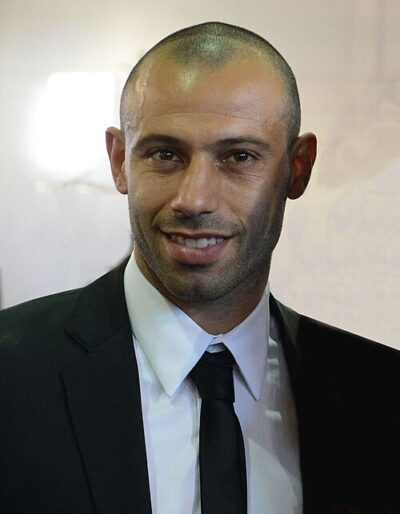
Javier Mascherano
Javier Mascherano is an Argentine association football player and manager. Born June 8, 1984, in San Lorenzo. Teams include S.C. Corinthians Paulista (2005–2006), Club Atlético River Plate (2003–2005) and West Ham United F.C. (2006–2007).
Facts
21 facts · 1 confirmed by two sources · 4 cited · 16 from one source
Where this comes from
Papalocal keeps its own record. It started from these sources; what each one said is kept here as it was copied, so a change on their side never changes this page by itself. Tap one to read its version.
What Wikidata says · copied November 16, 2026 · revision 2563645880
- Described as
- Argentine association football player and manager
- Other names
- Javier Alejandro Mascherano
- Born
- June 8, 1984 · 5 references
- Born in
- San Lorenzo · 2 references
- Name at birth
- Javier Alejandro Mascherano
- Citizen of
- Argentina; Italy · 1 reference
- Occupation
- association football player (–2020) · 1 reference; association football coach (2021–)
- Teams
- S.C. Corinthians Paulista (2005–2006); Club Atlético River Plate (2003–2005); West Ham United F.C. (2006–2007); FC Barcelona (2010–2018); Liverpool F.C. (2007–2010); Argentina national under-20 football team (2003–2004); Argentina national under-23 football team (2004–2008); Argentina national football team (2003–2016); Argentina national under-17 football team (2000–2001); Hebei F.C. (2018–2019); Estudiantes de La Plata (2019–2020)
- Sport
- association football
- Nickname
- El Jefe · 1 reference
- Height
- 1.74 m (5 ft 9 in)
- Wikipedias with a page
- 73
Wikidata item Q161571 (wikidata.org/wiki/Q161571), public domain (CC0). Copied November 16, 2026.
What Wikipedia says · copied November 16, 2026 · revision 1385093889
Javier Alejandro Mascherano (Spanish: [xaˈβjeɾ aleˈxandɾo mastʃeˈɾano], Italian: [maskeˈraːno]; born 8 June 1984) is an Argentine football manager and former player who was most recently the head coach of Major League Soccer club Inter Miami. As a player, he played as a centre-back or defensive midfielder, most notably for Liverpool, Barcelona and the Argentina national team, being heralded as one of the best defenders and midfielders of his generation.
Mascherano began his career at River Plate, where he earned his first senior honours, the Argentine Primera División, in the 2003–04 season. He moved to Brazilian side Corinthians in 2005, winning the Brazilian Série A that same year, and then joined West Ham United in the Premier League; however, his brief time with the Hammers was blighted by unusual contract terms with Global Soccer Agencies. At the beginning of 2007, Mascherano was loaned out to Liverpool and reached the UEFA Champions League final. Afterwards, his deal was made permanent for £18.7 million. He left for Barcelona in 2010, winning five La Liga titles, two Champions Leagues and two FIFA Club World Cups among other honours, in eight years. He ended his career in 2020 after spells at Hebei China Fortune and Estudiantes.
Mascherano made 147 appearances for the Argentina national team and is the second most capped player in the country's history (after Lionel Messi). From his debut in 2003 until his retirement in 2018, he represented the nation at five Copa América tournaments, finishing runner-up in 2004, 2007, 2015, and 2016, and four FIFA World Cups, reaching the 2014 final. He twice won a gold medal at the Summer Olympics, in 2004 and 2008, becoming the first male footballer to achieve this double feat since Hungarian defender Dezső Novák in 1968. Between 2008 and 2011, Mascherano served as the captain of Argentina.
Mascherano began working as a manager in 2022, with the Argentina under-20 and under-23 teams, coaching the latter at the 2024 Olympics. At the end of 2024 he was appointed by Inter Miami, where he won the MLS Cup in 2025.
- Born, in its opening lines
- June 8, 1984
From the Wikipedia article “Javier Mascherano” (en.wikipedia.org/wiki/Javier_Mascherano), by its contributors, under CC BY-SA 4.0 (creativecommons.org/licenses/by-sa/4.0/). Copied November 16, 2026; not changed.
Confirmed Two sources agree. Cited One source, and it names where it got it. One source One source, without a reference of its own. Sources disagree The sources disagree. We show the best-supported value and keep theirs below.
