
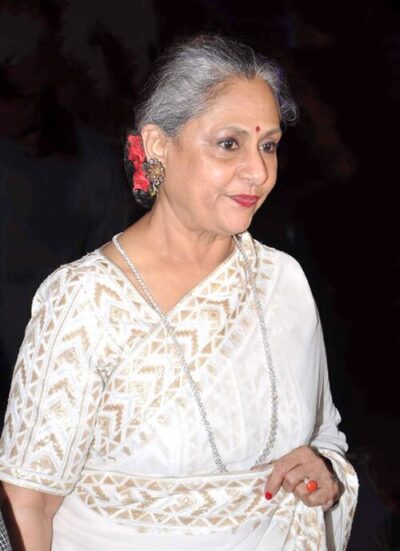
Jaya Bachchan
Jaya Bachchan is an Indian politician and actress. Born April 9, 1948, in Jabalpur. Positions held include member of Rajya Sabha (2004–). Known for Guddi, Abhimaan and Sholay. Educated at University of Calcutta and Loreto College. Awards include Padma Shri in Art, Filmfare Award for Best Actress (3 times) and Filmfare Award for Best Supporting Actress (3 times).
Facts
28 facts · 1 confirmed by two sources · 5 cited · 22 from one source
Where this comes from
Papalocal keeps its own record. It started from these sources; what each one said is kept here as it was copied, so a change on their side never changes this page by itself. Tap one to read its version.
What Wikidata says · copied November 16, 2026 · revision 2568913941
- Described as
- Indian politician and actress
- Other names
- Jaya Bhaduri Bachchan
- Born
- April 9, 1948
- Born in
- Jabalpur · 1 reference
- Citizen of
- India
- Occupation
- actor · 1 reference; politician; film actor
- Positions held
- member of Rajya Sabha (2004–) · 2 references
- Political party
- Samajwadi Party
- Education
- University of Calcutta; Loreto College; Film and Television Institute of India; St. Joseph's Convent School, Bhopal
- Known for
- Guddi; Abhimaan; Sholay; Nauker; Sometimes Happiness Sometimes Sadness...; Kal Ho Naa Ho
- Awards
- Padma Shri in Art (1992); Filmfare Award for Best Actress (3 times) (1974, 1975, 1980); Filmfare Award for Best Supporting Actress (3 times) (2001, 2002, 2004); Filmfare Lifetime Achievement Award (2007)
- Spouse
- Amitabh Bachchan (1973–) · 1 reference
- Children
- Abhishek Bachchan · 1 reference; Shweta Bachchan Nanda
- Father
- Tarun Kumar Bhaduri
- Religion
- Hinduism
- Lived in
- Mumbai
- Wikipedias with a page
- 58
Wikidata item Q464932 (wikidata.org/wiki/Q464932), public domain (CC0). Copied November 16, 2026.
What Wikipedia says · copied November 16, 2026 · revision 1384309054
Jaya Bachchan (née Bhaduri; born 9 April 1948) is an Indian actress and politician. She has served as a Member of Parliament in the Rajya Sabha from the Samajwadi Party since 2004. Known for her work in many Hindi films, she is noted for reinforcing a natural style of acting in both mainstream and "middle-of-the-road" cinema. Bachchan has received several accolades, including ten Filmfare Awards and the Padma Shri, the fourth-highest civilian honour awarded by the Government of India.
Bachchan made her film debut as a teenager in Satyajit Ray's Mahanagar (1963), and her first screen role as an adult was in Guddi (1971), directed by Hrishikesh Mukherjee, with whom she collaborated in several films thereafter. She was noted for her performances in films like Uphaar (1971), Koshish (1972) and Kora Kagaz (1974). Throughout the decade, she formed a successful screen partnership with her husband Amitabh Bachchan, opposite whom she starred in films such as Zanjeer (1973), Abhimaan (1973), Chupke Chupke (1975) and Mili (1975), as well as the cult film Sholay (1975). She won the Filmfare Award for Best Actress for Abhimaan, Kora Kagaz and Nauker (1979).
Following her marriage and the birth of their children, she restricted her work in films, notably starring in Silsila (1981) before quitting acting for an extended 17-year sabbatical. She returned to acting with Govind Nihalani's independent drama Hazaar Chaurasi Ki Maa (1998). Bachchan revived her career with a number of character parts following her comeback. She won three Filmfare Award for Best Supporting Actress for playing emotionally troubled mothers in the commercially successful dramas Fiza (2000), Kabhi Khushi Kabhie Gham... (2001) and Kal Ho Naa Ho (2003). After another hiatus, she appeared in Karan Johar's Rocky Aur Rani Kii Prem Kahaani (2023).
- Born, in its opening lines
- April 9, 1948
From the Wikipedia article “Jaya Bachchan” (en.wikipedia.org/wiki/Jaya_Bachchan), by its contributors, under CC BY-SA 4.0 (creativecommons.org/licenses/by-sa/4.0/). Copied November 16, 2026; not changed.
Confirmed Two sources agree. Cited One source, and it names where it got it. One source One source, without a reference of its own. Sources disagree The sources disagree. We show the best-supported value and keep theirs below.
