
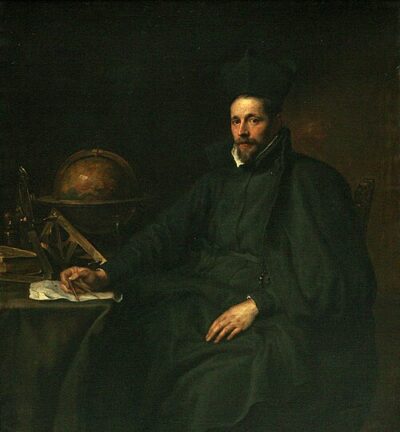
Jean-Charles de la Faille
Jean-Charles de la Faille was a Flemish Jesuit priest and mathematician born on March 1, 1597, in Antwerp. He passed away on November 4, 1652, in Barcelona. De la Faille was recognized for his contributions to mathematics and also worked as an educator.
Facts
16 facts · 0 confirmed by two sources · 14 cited · 2 from one source
Where this comes from
Papalocal keeps its own record. It started from these sources; what each one said is kept here as it was copied, so a change on their side never changes this page by itself. Tap one to read its version.
What Wikidata says · copied November 13, 2026 · revision 2567714322
- Described as
- Jesuit mathematician
- Other names
- Jan-Karel Della Faille, Jean-Charles della Faille
- Born
- March 1, 1597 · 3 references
- Died
- November 4, 1652 · 5 references
- Born in
- Antwerp · 1 reference
- Died in
- Barcelona · 1 reference
- Name at birth
- Jan Karel della Faille · 1 reference
- Occupation
- mathematician · 1 reference; pedagogue · 1 reference; Catholic priest
- Positions held
- hofmeister (1647–1652) · 1 reference
- Worked for
- Colegio Imperial de Madrid (1629–1651) · 1 reference; University of Dole (–1626) · 1 reference; Old University of Leuven (1626–1628) · 1 reference
- Education
- Our Lady College, Antwerp (–1613) · 1 reference; University of Dole (1620–) · 1 reference
- Field
- mathematics · 1 reference
- Religion
- Catholicism
- Wikipedias with a page
- 11
Wikidata item Q2034223 (wikidata.org/wiki/Q2034223), public domain (CC0). Copied November 13, 2026.
What Wikipedia says · copied November 13, 2026 · revision 1230701665
Jean-Charles della Faille (Dutch: Jan-Karel della Faille, Spanish: Juan Carlos della Faille), born in Antwerp, 1 March 1597 and died in Barcelona, 4 November 1652, was a Flemish Jesuit priest from Brabant, and a mathematician of repute.
From the Wikipedia article “Jean-Charles della Faille” (en.wikipedia.org/wiki/Jean-Charles_della_Faille), by its contributors, under CC BY-SA 4.0 (creativecommons.org/licenses/by-sa/4.0/). Copied November 13, 2026; not changed.
Confirmed Two sources agree. Cited One source, and it names where it got it. One source One source, without a reference of its own. Sources disagree The sources disagree. We show the best-supported value and keep theirs below.
