
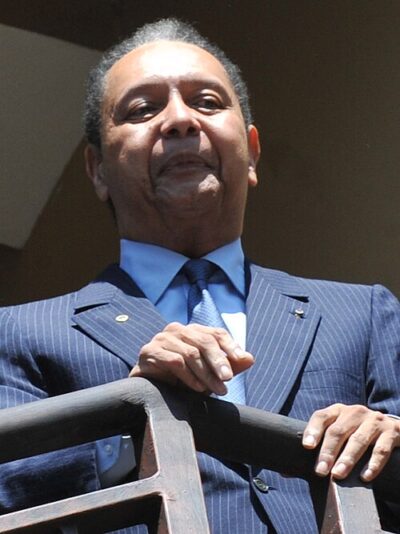
Jean-Claude Duvalier
Jean-Claude Duvalier was a President of the Republic of Haiti. Born July 3, 1951, in Port-au-Prince. Died October 4, 2014, in Port-au-Prince. Positions held include President of Haiti (1971–1986). Educated at State University of Haiti and Institution Saint-Louis de Gonzague.
Facts
16 facts · 2 confirmed by two sources · 4 cited · 10 from one source
Where this comes from
Papalocal keeps its own record. It started from these sources; what each one said is kept here as it was copied, so a change on their side never changes this page by itself. Tap one to read its version.
What Wikidata says · copied November 16, 2026 · revision 2565548836
- Described as
- President of the Republic of Haiti (1951-2014)
- Other names
- Bébé Doc
- Born
- July 3, 1951 · 9 references
- Died
- October 4, 2014 · 7 references
- Born in
- Port-au-Prince · 2 references
- Died in
- Port-au-Prince · 2 references
- Cause of death
- heart failure
- Citizen of
- Haiti
- Occupation
- politician · 1 reference
- Positions held
- President of Haiti (1971–1986)
- Political party
- National Unity Party
- Education
- State University of Haiti; Institution Saint-Louis de Gonzague
- Spouse
- Michèle Bennett (1980–1990)
- Father
- François Duvalier · 1 reference
- Mother
- Simone Duvalier
- Siblings
- Marie-Denise Duvalier
- Religion
- Catholicism
- Wikipedias with a page
- 54
Wikidata item Q310775 (wikidata.org/wiki/Q310775), public domain (CC0). Copied November 16, 2026.
What Wikipedia says · copied November 16, 2026 · revision 1378136159
Jean-Claude Duvalier (French: [ʒɑ̃klod dyvalje]; 3 July 1951 – 4 October 2014), nicknamed "Baby Doc" (Haitian Creole: Bebe Dòk, French: Bébé Doc), was a Haitian dictator who held the presidency of Haiti from 1971 until he was overthrown by a popular uprising in February 1986. He succeeded his father François "Papa Doc" Duvalier as the ruler of Haiti after his death in 1971. After assuming power, he introduced cosmetic changes to his father's regime and delegated much authority to his advisors. Thousands of Haitians were tortured and killed, and hundreds of thousands fled the country during his presidency. He maintained a notoriously lavish lifestyle (including a state-sponsored US$2 million wedding in 1980) while poverty among his people remained the most widespread of any country in the Western Hemisphere.
Relations with the United States improved after Duvalier's ascension to the presidency, and later deteriorated under the Carter administration, only to normalize under Ronald Reagan due to the strong anti-communist stance of the Duvaliers. Rebellion against the Duvalier regime broke out in 1985, and Duvalier fled to France in 1986 on a U.S. Air Force flight.
Duvalier unexpectedly returned to Haiti on 16 January 2011, after two decades in self-imposed exile in France. The following day, he was arrested by Haitian police, facing possible charges for embezzlement. On 18 January, Duvalier was charged with corruption. On 28 February 2013, Duvalier pleaded not guilty to charges of corruption and human rights abuse. He died of a heart attack on 4 October 2014, at the age of 63.
Transparency International determined that the money embezzled by Duvalier was the sixth most embezzled by a sitting head of government between 1984 and 2004.
- Born, in its opening lines
- July 3, 1951
- Died, in its opening lines
- October 4, 2014
From the Wikipedia article “Jean-Claude Duvalier” (en.wikipedia.org/wiki/Jean-Claude_Duvalier), by its contributors, under CC BY-SA 4.0 (creativecommons.org/licenses/by-sa/4.0/). Copied November 16, 2026; not changed.
Confirmed Two sources agree. Cited One source, and it names where it got it. One source One source, without a reference of its own. Sources disagree The sources disagree. We show the best-supported value and keep theirs below.
