
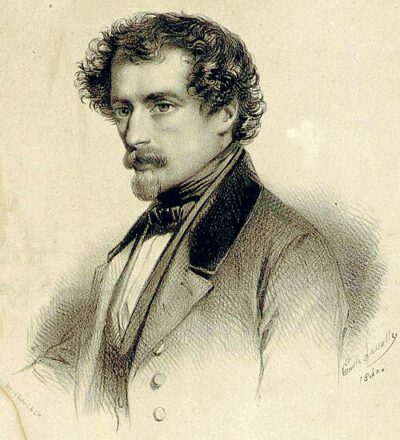
Jean Ignace Isidore Gérard Grandville
Jean Ignace Isidore Gérard Grandville was a French caricaturist. Born September 15, 1803, in Nancy. Died March 17, 1847, in Vanves. Known for Cent Proverbes.
Facts
18 facts · 1 confirmed by two sources · 12 cited · 4 from one source · 1 where the sources disagree
What’s different
- Born: we show September 15, 1803 (Sources disagree). Wikipedia says September 13, 1803
Where this comes from
Papalocal keeps its own record. It started from these sources; what each one said is kept here as it was copied, so a change on their side never changes this page by itself. Tap one to read its version.
What Wikidata says · copied November 16, 2026 · revision 2564792030
- Described as
- French caricaturist (1803-1847)
- Other names
- Jean-Jacques Grandville, Jean-Ignace-Isidore Gérard, J. I. Grandville, J. J. Grandville, Jean Ignace Isidore Gerard, Jean Ignace Isidore Gérard, Jean Ignace Isidore Gerard Grandville, Jean-Ignace-Isidore Gerard, Jean Isidore Gerard Grandville, Grandville, Jean-Jacques
- Born
- September 15, 1803 · 2 references
- Died
- March 17, 1847 · 5 references
- Born in
- Nancy · 3 references
- Died in
- Vanves · 1 reference
- Citizen of
- France · 1 reference
- Occupation
- caricaturist · 2 references; illustrator · 2 references; painter · 1 reference; lithographer · 2 references; draftsperson · 2 references; watercolorist · 1 reference; etcher · 1 reference
- Worked for
- Le Charivari
- Known for
- Cent Proverbes
- Field
- painting; caricature; young adult literature · 1 reference; erotic art · 1 reference
- Wikipedias with a page
- 28
Wikidata item Q744442 (wikidata.org/wiki/Q744442), public domain (CC0). Copied November 16, 2026.
What Wikipedia says · copied November 16, 2026 · revision 1373536872
Jean Ignace Isidore Gérard (French pronunciation: [ʒɑ̃ iɲas izidɔʁ ʒeʁaʁ]; 13 September 1803 – 17 March 1847) was a prolific French illustrator and caricaturist who published under the pseudonym of Grandville ([ɡʁɑ̃vil] ), and numerous variations (e. g. Jean-Jacques Grandville, Jean Ignace Isidore Grandville) throughout his career. Art historians and critics have called him "the first star of French caricature's great age", and described his illustrations as featuring "elements of the symbolic, dreamlike, and incongruous" while retaining a sense of social commentary, and "the strangest and most pernicious transfigurement of the human shape ever produced by the Romantic imagination". The anthropomorphic vegetables and zoomorphic figures that populated his cartoons anticipated and influenced the work of generations of cartoonists and illustrators from John Tenniel, to Gustave Doré, to Félicien Rops, and Walt Disney. He has also been called a "proto-surrealist" and was greatly admired by André Breton and others in the movement.
Grandville was born in 1803, in Nancy, France into a family of artist and actors and received his earliest instruction in drawing from his father. He moved to Paris about 1823–1825 and began designing illustrations. His reputation was established in 1829 when he published a set of 70 lithographs titled Les Métamorphoses du jour. During the July Revolution of 1830 and the turbulent years that followed, he worked with Honoré Daumier and others producing provocative political cartoons for periodicals that were highly critical of the new monarchy of Louis Philippe I. After strict censorship laws were passed and threats from the police in 1835, Grandville turned to book illustration. He illustrated several classics such as La Fontaine's Fables, Defoe's Robinson Crusoe, Swift's Gulliver's Travels, and Cervantes's Don Quixote. In later years his books were increasingly centered around his illustrations, with the text written for his images e.g. Un autre monde (1844), Cent proverbes: têxte par trois Tetes dans un bonnet (1845), and Les fleurs animées (1846). Grandville typically made drawings for publishers that were later copied into lithographs and woodcuts by professional engravers, only occasionally did he make his own prints.
He married his cousin Marguerite Henriette Fischer in 1833 and they had three sons, but Marguerite and all three sons predeceased him, all on separate occasions. He remarried in 1843 to Catherine Marceline "Céline" Lhuillier and they had one son, Armand in 1845. Traditional accounts say that he went mad and died in an insane asylum; however, recent authors say that although the hospital where he died in Paris, Maison de Santé in Vanves, did treat the mentally ill among other illnesses, he was not "mad" and likely died of a throat infection, possibly diphtheria.
- Born, in its opening lines
- September 13, 1803
- Died, in its opening lines
- March 17, 1847
From the Wikipedia article “Jean Ignace Isidore Gérard” (en.wikipedia.org/wiki/Jean_Ignace_Isidore_Gérard), by its contributors, under CC BY-SA 4.0 (creativecommons.org/licenses/by-sa/4.0/). Copied November 16, 2026; not changed.
Confirmed Two sources agree. Cited One source, and it names where it got it. One source One source, without a reference of its own. Sources disagree The sources disagree. We show the best-supported value and keep theirs below.
