
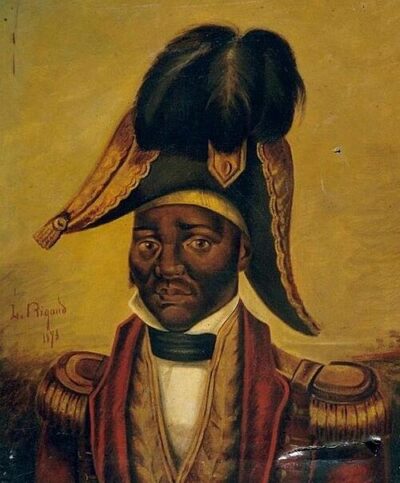
Jean-Jacques Dessalines
Jean-Jacques Dessalines was a Leader of Haitian Revolution and first ruler of independent Haiti. Born September 20, 1758, in Grande-Rivière-du-Nord. Died October 17, 1806, in Port-au-Prince. Positions held include Emperor of Haiti (1804–1806).
Facts
13 facts · 2 confirmed by two sources · 0 cited · 11 from one source
Where this comes from
Papalocal keeps its own record. It started from these sources; what each one said is kept here as it was copied, so a change on their side never changes this page by itself. Tap one to read its version.
What Wikidata says · copied November 16, 2026 · revision 2568058336
- Described as
- Leader of Haitian Revolution and first ruler of independent Haiti (1758-1806)
- Other names
- Jean Jacques Dessalines, Dessalines,Jean-Jacques, Jacques I, Jacques I of Haiti
- Born
- September 20, 1758 · 2 references
- Died
- October 17, 1806 · 4 references
- Born in
- Grande-Rivière-du-Nord
- Died in
- Port-au-Prince
- Name at birth
- Jean-Jacques Duclos
- Citizen of
- Saint-Domingue
- Occupation
- politician
- Positions held
- Emperor of Haiti (1804–1806)
- Spouse
- Marie-Claire Heureuse Félicité
- Children
- César-Jacques Dessalines; Jacques Aimé Dessalines
- Religion
- Catholicism
- Military rank
- general
- Wikipedias with a page
- 60
Wikidata item Q212068 (wikidata.org/wiki/Q212068), public domain (CC0). Copied November 16, 2026.
What Wikipedia says · copied November 16, 2026 · revision 1384679196
Jean-Jacques Dessalines (French pronunciation: [ʒɑ̃ ʒak dɛsalin]; Haitian Creole: Jan-Jak Desalin; 20 September 1758 – 17 October 1806) was a Haitian politician and revolutionary who led the Haitian Revolution and served as the Emperor of Haiti from 1804 to 1806 and the first leader of an independent Haiti under the 1805 constitution. Initially regarded as governor-general, Dessalines was later named Emperor of Haiti as Jacques I (1804–1806) by generals of the Indigenous Army and ruled in that capacity until being assassinated in 1806. He spearheaded the resistance against French rule of Saint-Domingue, and eventually became the architect of the 1804 massacre of the remaining White French residents of newly independent Haiti. Alongside Toussaint Louverture, he has been referred to as one of the fathers of the nation of Haiti. Under the rule of Dessalines, Haiti became the first country in the Americas to permanently abolish slavery.
Dessalines served as an officer in the French army when Saint-Domingue was fending off Spanish and British incursions. Later he rose to become a commander in the revolt against France. As Toussaint Louverture's principal lieutenant, he led many successful engagements, including the Battle of Crête-à-Pierrot. In 1802, Louverture was betrayed and captured, and sent to prison in France, where he died. Thereafter, Dessalines became the leader of the revolution and Général-Chef de l'Armée Indigène on 18 May 1803. His forces defeated the French army at the Battle of Vertières on 18 November 1803. Saint-Domingue was declared independent on 29 November and then as the independent Republic of Haiti on 1 January 1804, under the leadership of Dessalines, chosen by a council of generals to assume the office of governor-general.
He ordered the 1804 Haitian massacre of the remaining White French population in Haiti, killing between 3,000 and 5,000 people, and an exodus of thousands. Some historians cite the threat of a French reinvasion and reinstatement of slavery as one of the reasons for the massacre. Dessalines excluded surviving Polish Legionnaires, who had defected from the French, as well as Germans who did not take part in the slave trade. He granted them full citizenship and classified them as black. Tensions remained with the minority mixed-race population, who had gained some education and property during the colonial period.
As Emperor, Dessalines enforced plantation labor to promote the economy and began an autocratic rule. In 1806, he was assassinated by members of his own administration and dismembered by a violent mob shortly thereafter. By the beginning of the 20th century, Dessalines began to be reassessed as an icon of Haitian nationalism. The national anthem of Haiti, "La Dessalinienne", written in 1903, is named in his honor.
- Born, in its opening lines
- September 20, 1758
- Died, in its opening lines
- October 17, 1806
From the Wikipedia article “Jean-Jacques Dessalines” (en.wikipedia.org/wiki/Jean-Jacques_Dessalines), by its contributors, under CC BY-SA 4.0 (creativecommons.org/licenses/by-sa/4.0/). Copied November 16, 2026; not changed.
Confirmed Two sources agree. Cited One source, and it names where it got it. One source One source, without a reference of its own. Sources disagree The sources disagree. We show the best-supported value and keep theirs below.
