
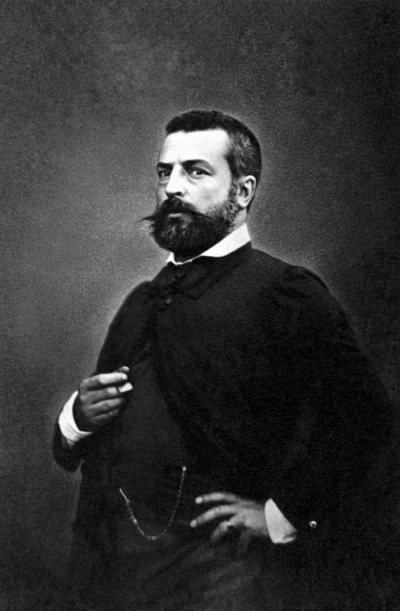
Jean-Louis-Ernest Meissonier
Jean-Louis-Ernest Meissonier was a French painter and sculptor. Born February 21, 1815, in Lyon. Died January 31, 1891, in Paris. Positions held include Mayor of Poissy (1878–1879) and chairperson (1890–). Known for 1814, La Campagne de France, Antibes. La promenade à cheval and Au cabaret. Reître et lévrier. Educated at Lycée Charlemagne. Awards include Grand Cross of the Legion of Honour, Grand Officer of the Legion of Honour and Commander of the Legion of Honour.
Facts
36 facts · 2 confirmed by two sources · 10 cited · 24 from one source
Where this comes from
Papalocal keeps its own record. It started from these sources; what each one said is kept here as it was copied, so a change on their side never changes this page by itself. Tap one to read its version.
What Wikidata says · copied November 16, 2026 · revision 2569333073
- Described as
- French painter and sculptor (1815-1891)
- Other names
- Jean Louis Ernest Meissonier, Ernest Meissonier, Jean-Louis Ernest Meissonier, Meissonier, E. Meissonnier, Jean Louis Meissonier, Jean Louis Ernest Meissonnier, Meissonnier, Jean Louis Ernst Meissonier, Messonier, J. L. E. Meissonier, E. Meissonier
- Born
- February 21, 1815 · 12 references
- Died
- January 31, 1891 · 10 references
- Born in
- Lyon · 1 reference
- Died in
- Paris · 1 reference
- Buried in
- Poissy
- Name at birth
- Jean-Louis-Ernest Meissonier · 1 reference
- Citizen of
- France · 1 reference
- Occupation
- sculptor · 2 references; painter · 4 references; politician; illustrator · 2 references; exlibrist · 1 reference; miniature painter · 1 reference; draftsperson · 1 reference; etcher · 1 reference
- Positions held
- Mayor of Poissy (1878–1879); chairperson (1890–)
- Education
- Lycée Charlemagne
- Member of
- Société héliographique; Royal Academy of Arts; Royal Swedish Academy of Fine Arts; Société nationale des beaux-arts; Académie des beaux-arts
- Genre
- portrait
- Known for
- 1814, La Campagne de France; Antibes. La promenade à cheval; Au cabaret. Reître et lévrier
- Awards
- Grand Cross of the Legion of Honour (1889) · 1 reference; Grand Officer of the Legion of Honour (1880) · 1 reference; Commander of the Legion of Honour (1867) · 1 reference; Officer of the Legion of Honour (1856) · 1 reference; Knight of the Legion of Honour (1846) · 1 reference
- Field
- painting
- Spouse
- Élisa Meissonier; Emma Steinheil
- Children
- Charles Meissonier
- Wikipedias with a page
- 38
Wikidata item Q354786 (wikidata.org/wiki/Q354786), public domain (CC0). Copied November 16, 2026.
What Wikipedia says · copied November 16, 2026 · revision 1382591118
Jean-Louis-Ernest Meissonier (French: [ʒɑ̃ lwi ɛʁnɛst mɛsɔnje]; 21 February 1815 – 31 January 1891) was a French academic painter and sculptor. He became famous for his depictions of Napoleon and his military sieges and manoeuvres in paintings acclaimed both for the artist's mastery of fine detail and his assiduous craftsmanship. The English art critic John Ruskin examined his work at length under a magnifying glass, "marvelling at Meissonier's manual dexterity and eye for fascinating minutiae." Meissonier enjoyed great success in his lifetime, becoming, with Gérôme and Cabanel, one of "the three most successful artists of the Second Empire."
Meissonier's work commanded enormous prices and in 1846 he purchased a great mansion in Poissy, sometimes known as the Grande Maison. The Grande Maison included two large studios, the atelier d'hiver, or winter workshop, situated on the top floor of the house, and at ground level, a glass-roofed annexe, the atelier d'été or summer workshop. Meissonier himself said that his house and temperament belonged to another age, and some, like the critic Paul Mantz for example, criticised the artist's seemingly limited repertoire. Like Alexandre Dumas, he excelled at depicting scenes of chivalry and masculine adventure against a backdrop of pre-Revolutionary and pre-industrial France, specialising in scenes from seventeenth- and eighteenth-century life.
- Born, in its opening lines
- February 21, 1815
- Died, in its opening lines
- January 31, 1891
From the Wikipedia article “Ernest Meissonier” (en.wikipedia.org/wiki/Ernest_Meissonier), by its contributors, under CC BY-SA 4.0 (creativecommons.org/licenses/by-sa/4.0/). Copied November 16, 2026; not changed.
Confirmed Two sources agree. Cited One source, and it names where it got it. One source One source, without a reference of its own. Sources disagree The sources disagree. We show the best-supported value and keep theirs below.
