
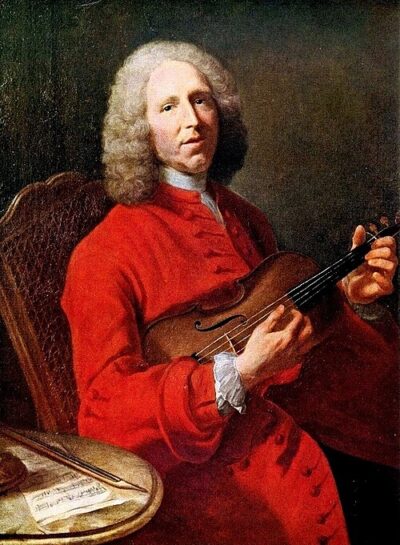
Jean-Philippe Rameau
Jean-Philippe Rameau was a French composer and music theorist. Born September 25, 1683, in Dijon. Died September 12, 1764, in Paris. Known for Dardanus, Pièces de clavecin en concerts and Traité de l'harmonie réduite à ses principes naturels. Educated at Collège des Godrans. Awards include Order of Saint Michael.
Facts
32 facts · 2 confirmed by two sources · 7 cited · 23 from one source
Where this comes from
Papalocal keeps its own record. It started from these sources; what each one said is kept here as it was copied, so a change on their side never changes this page by itself. Tap one to read its version.
What Wikidata says · copied November 16, 2026 · revision 2568846124
- Described as
- French composer and music theorist (1683–1764)
- Other names
- Jean Philippe Rameau
- Born
- September 25, 1683 · 10 references
- Died
- September 12, 1764 · 11 references
- Born in
- Dijon · 3 references
- Died in
- Paris · 3 references
- Buried in
- Church of Saint Eustache
- Citizen of
- Kingdom of France
- Occupation
- composer · 1 reference; choreographer; musicologist · 2 references; music theorist; organist · 2 references; harpsichordist · 1 reference; theorist · 1 reference; writer · 1 reference
- Education
- Collège des Godrans
- Member of
- Académie des Sciences, Arts et Belles-Lettres de Dijon
- Instrument
- violin
- Known for
- Dardanus; Pièces de clavecin en concerts; Traité de l'harmonie réduite à ses principes naturels; Pièces de Clavecin; Castor et Pollux; Les Indes galantes; Hippolyte et Aricie; Platée
- Awards
- Order of Saint Michael · 1 reference
- Field
- opera; chamber music; choral music
- Spouse
- Marie-Louise Mangot
- Children
- Claude-François Rameau
- Siblings
- Claude Rameau
- Wikipedias with a page
- 71
Wikidata item Q1145 (wikidata.org/wiki/Q1145), public domain (CC0). Copied November 16, 2026.
What Wikipedia says · copied November 16, 2026 · revision 1381408006
Jean-Philippe Rameau (; French: [ʒɑ̃filip ʁamo]; (1683-09-25)25 September 1683 – (1764-09-12)12 September 1764) was a French composer and music theorist of the late Baroque era. Regarded as one of the most important French composers and music theorists of the 18th century, he replaced Jean-Baptiste Lully as the dominant composer of French opera and is also considered the leading French composer of his time for the harpsichord, alongside François Couperin.
Little is known about Rameau's early years. It was not until the 1720s that he won fame as a major theorist of music with his Treatise on Harmony (1722) and also in the following years as a composer of masterpieces for the harpsichord, which circulated throughout Europe. He was almost 50 before he embarked on the operatic career on which his reputation chiefly rests today. His debut, Hippolyte et Aricie (1733), caused a great stir and was fiercely attacked by the supporters of Lully's style of music for its revolutionary use of harmony.
Nevertheless, Rameau's pre-eminence in the field of French opera was soon acknowledged, and he was later attacked as an "establishment" composer by those who favoured Italian opera during the controversy known as the Querelle des Bouffons in the 1750s. Rameau's music had gone out of fashion by the end of the 18th century, and it was not until the 20th that serious efforts were made to revive it. Today, his work is frequently performed and recorded.
- Born, in its opening lines
- September 25, 1683
- Died, in its opening lines
- September 12, 1764
From the Wikipedia article “Jean-Philippe Rameau” (en.wikipedia.org/wiki/Jean-Philippe_Rameau), by its contributors, under CC BY-SA 4.0 (creativecommons.org/licenses/by-sa/4.0/). Copied November 16, 2026; not changed.
Confirmed Two sources agree. Cited One source, and it names where it got it. One source One source, without a reference of its own. Sources disagree The sources disagree. We show the best-supported value and keep theirs below.
