
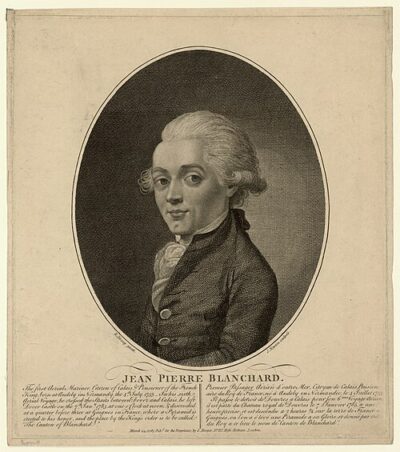
Jean-Pierre Blanchard
Jean-Pierre Blanchard was a French inventor and aviation pioneer. Born July 4, 1753, in Les Andelys. Died March 7, 1809, in Paris. Awards include Aviation Hall of Fame and Museum of New Jersey.
Facts
12 facts · 2 confirmed by two sources · 2 cited · 8 from one source
Where this comes from
Papalocal keeps its own record. It started from these sources; what each one said is kept here as it was copied, so a change on their side never changes this page by itself. Tap one to read its version.
What Wikidata says · copied November 16, 2026 · revision 2567390726
- Described as
- French inventor and aviation pioneer
- Other names
- Pierre Blanchard, Jean-Pierre [François] Blanchard, François Blanchard
- Born
- July 4, 1753 · 6 references
- Died
- March 7, 1809 · 6 references
- Born in
- Les Andelys · 1 reference
- Died in
- Paris
- Cause of death
- falling from height
- Citizen of
- France
- Occupation
- inventor; balloonist · 1 reference
- Awards
- Aviation Hall of Fame and Museum of New Jersey
- Spouse
- Sophie Blanchard
- Lived in
- Les Andelys (1753–1781); Paris (1781–1809)
- Wikipedias with a page
- 28
Wikidata item Q366649 (wikidata.org/wiki/Q366649), public domain (CC0). Copied November 16, 2026.
What Wikipedia says · copied November 16, 2026 · revision 1380122981
Jean-Pierre [François] Blanchard (French pronunciation: [ʒɑ̃ pjɛʁ blɑ̃ʃaʁ]; 4 July 1753 – 7 March 1809) was a French inventor, best known as a pioneer of gas balloon flight, who distinguished himself in the conquest of the air in a balloon, in particular the first aerial crossing of the English Channel, on 7 January 1785.
- Born, in its opening lines
- July 4, 1753
- Died, in its opening lines
- March 7, 1809
From the Wikipedia article “Jean-Pierre Blanchard” (en.wikipedia.org/wiki/Jean-Pierre_Blanchard), by its contributors, under CC BY-SA 4.0 (creativecommons.org/licenses/by-sa/4.0/). Copied November 16, 2026; not changed.
Confirmed Two sources agree. Cited One source, and it names where it got it. One source One source, without a reference of its own. Sources disagree The sources disagree. We show the best-supported value and keep theirs below.
