
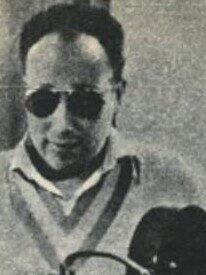
Jean-Pierre Melville
Jean-Pierre Melville was a French filmmaker and actor. Born October 20, 1917, in 9th arrondissement of Paris. Died August 2, 1973, in 13th arrondissement of Paris. Educated at Lycée Michelet, Vanves. Awards include Knight of the Legion of Honour.
Facts
18 facts · 2 confirmed by two sources · 11 cited · 5 from one source
Where this comes from
Papalocal keeps its own record. It started from these sources; what each one said is kept here as it was copied, so a change on their side never changes this page by itself. Tap one to read its version.
What Wikidata says · copied November 16, 2026 · revision 2557957180
- Described as
- French filmmaker and actor (1917–1973)
- Born
- October 20, 1917 · 10 references
- Died
- August 2, 1973 · 9 references
- Born in
- 9th arrondissement of Paris · 1 reference
- Died in
- 13th arrondissement of Paris · 1 reference
- Buried in
- Cimetière de Pantin
- Cause of death
- myocardial infarction
- Name at birth
- Jean-Pierre Claude Grumbach · 1 reference
- Citizen of
- France
- Occupation
- actor · 1 reference; film director · 2 references; screenwriter · 1 reference; film producer · 1 reference; director · 2 references; film actor · 1 reference; film editor · 1 reference
- Education
- Lycée Michelet, Vanves
- Awards
- Knight of the Legion of Honour · 1 reference
- Siblings
- Jacques Grumbach
- Wikipedias with a page
- 44
Wikidata item Q168693 (wikidata.org/wiki/Q168693), public domain (CC0). Copied November 16, 2026.
What Wikipedia says · copied November 16, 2026 · revision 1372225017
Jean-Pierre Grumbach (20 October 1917 – 2 August 1973), known professionally as Jean-Pierre Melville (French: [ʒɑ̃ pjɛʁ mɛlvil]), was a French filmmaker. Considered a spiritual godfather of the French New Wave, he was one of the first fully-independent French filmmakers to achieve commercial and critical success. His works include the crime dramas Bob le flambeur (1956), Le Doulos (1962), Le Samouraï (1967), and Le Cercle Rouge (1970), and the war films Le Silence de la mer (1949) and Army of Shadows (1969).
Melville's subject matter and approach to film making was influenced by his service in the French Resistance during World War II, during which he adopted the nom de guerre (pseudonym) 'Melville' as a tribute to his favorite American author Herman Melville. He kept it as his stage name once the war was over.
His sparse, existentialist but stylish approach to film noir and later neo-noir films, many of them crime dramas, have been highly influential to future generations of filmmakers. Roger Ebert appraised him as "one of the greatest directors."
- Born, in its opening lines
- October 20, 1917
- Died, in its opening lines
- August 2, 1973
From the Wikipedia article “Jean-Pierre Melville” (en.wikipedia.org/wiki/Jean-Pierre_Melville), by its contributors, under CC BY-SA 4.0 (creativecommons.org/licenses/by-sa/4.0/). Copied November 16, 2026; not changed.
Confirmed Two sources agree. Cited One source, and it names where it got it. One source One source, without a reference of its own. Sources disagree The sources disagree. We show the best-supported value and keep theirs below.
