
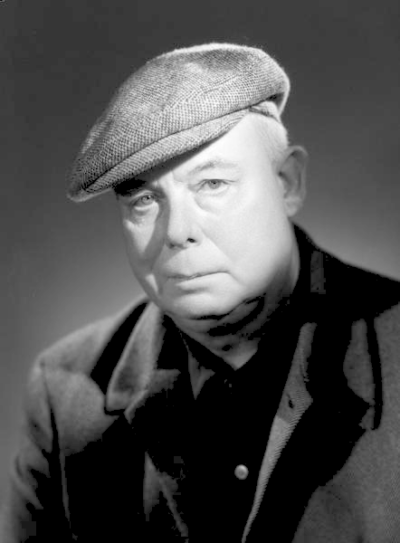
Jean Renoir
Jean Renoir was a French film director and screenwriter. Born September 15, 1894, in Montmartre. Died February 12, 1979, in Beverly Hills. Awards include Commander of the Legion of Honour, Louis Delluc Prize and Academy Honorary Award.
Facts
30 facts · 2 confirmed by two sources · 12 cited · 16 from one source
Where this comes from
Papalocal keeps its own record. It started from these sources; what each one said is kept here as it was copied, so a change on their side never changes this page by itself. Tap one to read its version.
What Wikidata says · copied November 16, 2026 · revision 2565534564
- Described as
- French film director and screenwriter (1894–1979)
- Born
- September 15, 1894 · 14 references
- Died
- February 12, 1979 · 14 references
- Born in
- Montmartre · 1 reference
- Died in
- Beverly Hills · 5 references
- Buried in
- Essoyes
- Citizen of
- France · 1 reference
- Occupation
- film director · 4 references; actor · 4 references; screenwriter · 6 references; film producer · 1 reference; film editor; author · 2 references; novelist; producer
- Member of
- American Academy of Arts and Sciences
- Awards
- Commander of the Legion of Honour; Louis Delluc Prize (1937); Academy Honorary Award (1974) · 1 reference; Prix Charles Blanc (1963); star on Hollywood Walk of Fame · 1 reference
- Spouse
- Catherine Hessling (1920–1943) · 1 reference; Dido Freire (1944–1979)
- Children
- Alain Renoir · 1 reference
- Father
- Pierre-Auguste Renoir · 1 reference
- Mother
- Aline Charigot
- Siblings
- Pierre Renoir · 1 reference; Claude Renoir
- Lived in
- Beverly Hills; Château des Brouillards
- Website
- http://www.jeanrenoir.com/
- Wikipedias with a page
- 72
Wikidata item Q50713 (wikidata.org/wiki/Q50713), public domain (CC0). Copied November 16, 2026.
What Wikipedia says · copied November 16, 2026 · revision 1371578503
Jean Renoir (French: [ʁənwaʁ]; 15 September 1894 – 12 February 1979) was a French filmmaker, actor, producer and author. His La Grande Illusion (1937) and The Rules of the Game (1939) are often cited by critics as among the greatest films ever made. In 2002, he was ranked fourth on the BFI's Sight & Sound poll of the greatest directors. Among numerous honours accrued during his lifetime, he received a Lifetime Achievement Academy Award in 1975. Renoir was the son of the painter Pierre-Auguste Renoir and the uncle of the cinematographer Claude Renoir. With Claude, he made The River (1951), the first color film shot in India. A lifelong lover of theater, Renoir turned to the stage for The Golden Coach (1952) and French Cancan (1955). He was one of the first filmmakers to be known as an auteur; the critic Penelope Gilliatt said a Renoir shot could be identified "in a thousand miles of film."
Pauline Kael wrote that "At his greatest, Jean Renoir expresses the beauty in our common humanity—the desires and hopes, the absurdities and follies, that we all, to one degree or another, share." Per The New York Times: "The style that ran through Mr. Renoir's films — a mixture of tenderness, irony and Gallic insouciance‐was caught in a famous line from his 1939 masterpiece, The Rules of the Game. It was spoken by Octave, played by the director himself: 'You see, in this world, there is one awful thing, and that is that everyone has his reasons.'"
- Born, in its opening lines
- September 15, 1894
- Died, in its opening lines
- February 12, 1979
From the Wikipedia article “Jean Renoir” (en.wikipedia.org/wiki/Jean_Renoir), by its contributors, under CC BY-SA 4.0 (creativecommons.org/licenses/by-sa/4.0/). Copied November 16, 2026; not changed.
Confirmed Two sources agree. Cited One source, and it names where it got it. One source One source, without a reference of its own. Sources disagree The sources disagree. We show the best-supported value and keep theirs below.
