
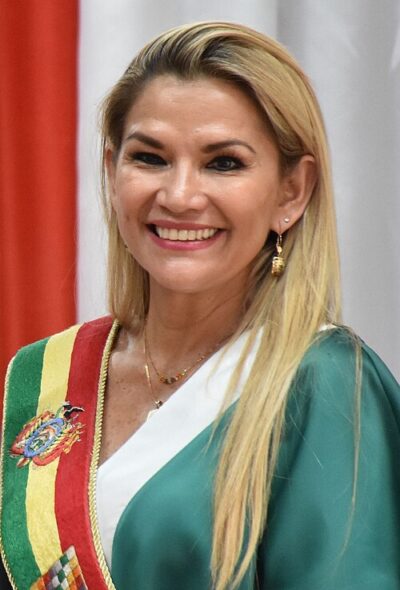
Jeanine Áñez
Jeanine Áñez is a Bolivian politician and Former President of Bolivia. Born June 13, 1967, in San Joaquín. Positions held include senator of Bolivia (2010–2019) and president of Bolivia (2019–2020). Educated at Universidad Autónoma del Beni.
Facts
14 facts · 1 confirmed by two sources · 2 cited · 11 from one source
Where this comes from
Papalocal keeps its own record. It started from these sources; what each one said is kept here as it was copied, so a change on their side never changes this page by itself. Tap one to read its version.
What Wikidata says · copied November 16, 2026 · revision 2564203322
- Described as
- Bolivian politician and Former President of Bolivia (2019–2020)
- Other names
- Jeanine Áñez Chávez
- Born
- June 13, 1967 · 1 reference
- Born in
- San Joaquín · 1 reference
- Name at birth
- Jeanine Áñez Chávez
- Citizen of
- Bolivia
- Occupation
- politician · 1 reference
- Positions held
- senator of Bolivia (2010–2019); president of Bolivia (2019–2020)
- Political party
- Plan Progress for Bolivia – National Convergence · 1 reference; Democrat Social Movement · 1 reference
- Education
- Universidad Autónoma del Beni
- Field
- politician · 1 reference
- Children
- Carolina Ribera
- Religion
- Catholicism · 1 reference
- Lived in
- Miraflores Women's Penitentiary
- Wikipedias with a page
- 62
Wikidata item Q16581287 (wikidata.org/wiki/Q16581287), public domain (CC0). Copied November 16, 2026.
What Wikipedia says · copied November 16, 2026 · revision 1378686449
Jeanine Áñez Chávez (Latin American Spanish: [ɟʝeˈnine ˈaɲes ˈtʃaβes] ; born 13 June 1967) is a Bolivian lawyer, politician, and television presenter who served as the 66th president of Bolivia from 2019 to 2020. A former member of the Social Democratic Movement, she previously served two terms as senator for Beni from 2015 to 2019 on behalf of the Democratic Unity coalition and from 2010 to 2014 on behalf of the National Convergence alliance. During this time, she served as second vice president of the Senate from 2015 to 2016 and in 2019 and, briefly, was president of the Senate, also in 2019. Before that, she served as a uninominal member of the Constituent Assembly from Beni, representing circumscription 61 from 2006 to 2007 on behalf of the Social Democratic Power alliance.
Born in San Joaquín, Beni, Áñez graduated as a lawyer from the José Ballivián Autonomous University, then worked in television journalism. An early advocate of departmental autonomy, in 2006, she was invited by the Social Democratic Power alliance to represent Beni in the 2006–2007 Constituent Assembly, charged with drafting a new constitution for Bolivia. Following the completion of that historic process, Áñez ran for senator for Beni with the National Convergence alliance, becoming one of the few former constituents to maintain a political career at the national level. Once in the Senate, the National Convergence caucus quickly fragmented, leading Áñez to abandon it in favor of the emergent Social Democratic Movement, an autonomist political party based in the eastern departments. Together with the Democrats, as a component of the Democratic Unity coalition, she was reelected senator in 2014. During her second term, Áñez served twice as second vice president of the Senate, making her the highest-ranking opposition legislator in that chamber during the social unrest the country faced in late 2019.
During this political crisis, and after the resignation of President Evo Morales and other officials in the line of succession, Áñez declared herself next in line to assume the presidency. On 12 November 2019, she installed an extraordinary session of the Plurinational Legislative Assembly that lacked quorum due to the absence of members of Morales' party, the Movement for Socialism (MAS-IPSP), who demanded security guarantees before attending. In a short session, Áñez declared herself president of the Senate, then used that position as a basis to assume constitutional succession to the presidency of the country endorsed by the Supreme Court of Justice. Responding to domestic unrest, Áñez issued a decree removing criminal liability for military and police in dealing with protesters, which was repealed amid widespread condemnation following the Senkata and Sacaba massacres. Her government launched numerous criminal investigations into former MAS officials, for which she was accused of political persecution and retributive justice, terminated Bolivia's close links with the governments of Cuba, Nicaragua, and Venezuela, and warmed relations with the United States. After delays due to the COVID-19 pandemic and ensuing protests, new elections were held in October 2020. Despite initially pledging not to, Áñez launched her own presidential campaign, contributing to criticism that she was not a neutral actor in the transition. She withdrew her candidacy a month before the election amid low poll numbers and fear of splitting the opposition vote against MAS candidate Luis Arce, who won the election.
Following the end of her mandate in November 2020, Áñez briefly retired to her residence in Trinidad, only to launch her Beni gubernatorial candidacy a month later. Despite being initially competitive, mounting judicial processes surrounding her time as president hampered her campaign, ultimately resulting in a third-place finish at the polls. Eight days after the election, Áñez was apprehended and charged with crimes related to her role in the alleged coup d'état of 2019, a move decried as political persecution by members of the political opposition and some in the international community, including the United States and European Union. Áñez's nearly fifteen month pre-trial detention caused a marked decline in her physical and mental health, and was denounced as abusive by her family. On 10 June 2022, after a three-month trial, the First Sentencing Court of La Paz found Áñez guilty of breach of duties and resolutions contrary to the Constitution, sentencing her to ten years in prison. Following the verdict, her defense conveyed its intent to appeal, as did government prosecutors, seeking a harsher sentence. On 5 November 2025, Áñez's conviction was annulled by the Supreme Tribunal of Justice of Bolivia and she was subsequently released from imprisonment.
- Born, in its opening lines
- June 13, 1967
From the Wikipedia article “Jeanine Áñez” (en.wikipedia.org/wiki/Jeanine_Áñez), by its contributors, under CC BY-SA 4.0 (creativecommons.org/licenses/by-sa/4.0/). Copied November 16, 2026; not changed.
Confirmed Two sources agree. Cited One source, and it names where it got it. One source One source, without a reference of its own. Sources disagree The sources disagree. We show the best-supported value and keep theirs below.
