
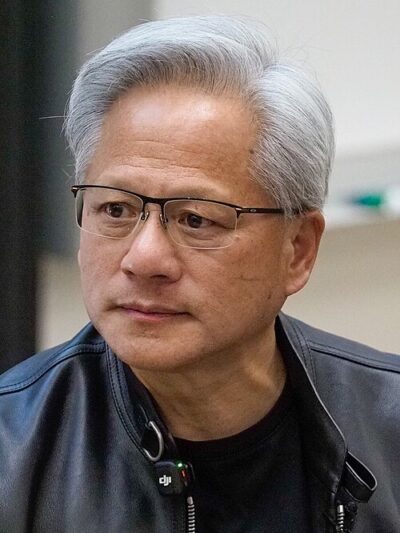
Jensen Huang
Jensen Huang is a Taiwanese-American entrepreneur and businessman; co-founder and former CEO of Nvidia. Born February 17, 1963, in Taipei. Positions held include chief executive officer (1993–2026). Educated at Oregon State University and Stanford University. Awards include IEEE Founders Medal, Time 100 (2 times) and Queen Elizabeth Prize for Engineering.

Facts
30 facts · 1 confirmed by two sources · 18 cited · 11 from one source
Where this comes from
Papalocal keeps its own record. It started from these sources; what each one said is kept here as it was copied, so a change on their side never changes this page by itself. Tap one to read its version.
What Wikidata says · copied November 14, 2026 · revision 2569146415
- Described as
- Taiwanese-American entrepreneur and businessman; co-founder and former CEO of Nvidia
- Other names
- Jen-hsun Jensen Huang, Jen-Hsun Huang, Huang Jen-hsun, Jen-hsun Huang, Huang Renxun
- Born
- February 17, 1963 · 1 reference
- Born in
- Taipei · 1 reference
- Citizen of
- Taiwan; United States
- Occupation
- entrepreneur · 1 reference; computer scientist; electrical engineer · 1 reference; manager · 1 reference; founder · 1 reference; chief executive officer · 1 reference
- Positions held
- chief executive officer (1993–2026)
- Education
- Oregon State University (1980–1984) · 1 reference; Stanford University (–1992); Aloha High School; Oneida Baptist Institute · 1 reference; Ruamrudee International School
- Member of
- Committee of 100; RAND Corporation · 1 reference
- Sport
- table tennis · 1 reference
- Awards
- IEEE Founders Medal (2020) · 1 reference; Time 100 (2 times) (2021, 2024) · 1 reference; Queen Elizabeth Prize for Engineering (2025) · 1 reference; National Medal of Science (2026) · 1 reference; Dostyk Order of grade I
- Field
- entrepreneurship · 1 reference; artificial intelligence · 1 reference; graphics processing unit · 1 reference
- Spouse
- Lori Mills Huang (1985–) · 2 references
- Lived in
- United States · 1 reference
- Nickname
- don huang
- Wikipedias with a page
- 67
Wikidata item Q305177 (wikidata.org/wiki/Q305177), public domain (CC0). Copied November 14, 2026.
What Wikipedia says · copied November 14, 2026 · revision 1385631946
Jen-Hsun "Jensen" Huang (born February 17, 1963) is a Taiwanese and American electrical engineer and businessman. He co-founded the technology company Nvidia, one of the world's most valuable corporations, and served as its president and CEO from its founding in 1993 until his resignation in November 2026. As of November 2026, Forbes estimates his net worth at over US$150 billion, making him the eleventh-wealthiest person in the world.
Born in Taipei, Huang spent his childhood in Taiwan and Thailand before immigrating to the United States. After earning a master's degree from Stanford University, he launched Nvidia alongside Chris Malachowsky and Curtis Priem from a Denny's restaurant in San Jose, California, in 1993 at age 30. Huang led the company out of near-bankruptcy during the 1990s and oversaw its expansion from graphics processing unit (GPU) development into high-performance computing and artificial intelligence (AI).
Under Huang's leadership, Nvidia experienced rapid growth during the AI boom, becoming the first company to reach a market capitalization of over $5 trillion in October 2025. In 2021 and 2024, Time magazine included him in its list of the most influential people. In 2025, Huang was named as one of the "Architects of AI" for Time's Person of the Year. In November 2026, a scandal emerged where it was reported that he had had multiple affairs, including one with Alice Huang, whom the U.S. government suspects may have been a spy for China. As a result, on November 12, Huang resigned from his positions at Nvidia, and the company confirmed he would have no formal role at the firm going forward.
- Born, in its opening lines
- February 17, 1963
From the Wikipedia article “Jensen Huang” (en.wikipedia.org/wiki/Jensen_Huang), by its contributors, under CC BY-SA 4.0 (creativecommons.org/licenses/by-sa/4.0/). Copied November 14, 2026; not changed.
Confirmed Two sources agree. Cited One source, and it names where it got it. One source One source, without a reference of its own. Sources disagree The sources disagree. We show the best-supported value and keep theirs below.
