
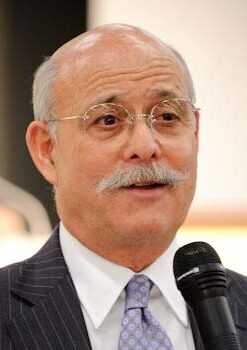
Jeremy Rifkin
Jeremy Rifkin is an American economist. Born January 26, 1945, in Denver. Known for Entropy: A New World View, The End of Work and The European Dream. Educated at The Wharton School and The Fletcher School of Law and Diplomacy. Awards include Corine Literature Prize, honorary doctorate of Hasselt University and Honorary doctor of the University of Liège.
Facts
23 facts · 1 confirmed by two sources · 9 cited · 13 from one source
Where this comes from
Papalocal keeps its own record. It started from these sources; what each one said is kept here as it was copied, so a change on their side never changes this page by itself. Tap one to read its version.
What Wikidata says · copied November 13, 2026 · revision 2564441216
- Described as
- American economist
- Other names
- J. Rifkin, Rifkin
- Born
- January 26, 1945 · 4 references
- Born in
- Denver · 1 reference
- Citizen of
- United States
- Occupation
- economist · 1 reference; sociologist · 1 reference; writer; university teacher; prognostician · 1 reference; political scientist · 1 reference; opinion journalist · 1 reference; philosopher · 1 reference
- Worked for
- The Wharton School
- Education
- The Wharton School (–1967); The Fletcher School of Law and Diplomacy (–1968); Morgan Park High School
- Known for
- Entropy: A New World View; The End of Work; The European Dream; The Empathic Civilization; The Third Industrial Revolution
- Awards
- Corine Literature Prize (2005); honorary doctorate of Hasselt University (2015) · 1 reference; Honorary doctor of the University of Liège (2006) · 1 reference
- Wikipedias with a page
- 43
Wikidata item Q505154 (wikidata.org/wiki/Q505154), public domain (CC0). Copied November 13, 2026.
What Wikipedia says · copied November 13, 2026 · revision 1379804309
Jeremy Rifkin (born January 26, 1945) is an American economic and social theorist, writer, public speaker, political advisor, and activist. Rifkin is the author of 23 books about the influence of scientific and technological changes on the economy, the workforce, society, and the environment. His most recent books include The Age of Resilience (2022), The Green New Deal (2019), The Zero Marginal Cost Society (2014), The Third Industrial Revolution (2011), The Empathic Civilization (2010), and The European Dream (2004).
Rifkin is the principal architect of the "Third Industrial Revolution" long-term economic sustainability plan to address the triple challenge of the global economic crisis, energy security, and climate change. The Third Industrial Revolution (TIR) was formally endorsed by the European Parliament in 2007.
The Huffington Post reported from Beijing in October 2015 that "Chinese Premier Li Keqiang has not only read Jeremy Rifkin's book, The Third Industrial Revolution, but taken it to heart", he and his colleagues having incorporated ideas from this book into the core of the country's thirteenth Five-Year Plan. According to EurActiv, "Jeremy Rifkin is an American economist and author whose best-selling Third Industrial Revolution arguably provided the blueprint for Germany's transition to a low-carbon economy, and China's strategic acceptance of climate policy."
Rifkin has taught at the Wharton School executive education program at the University of Pennsylvania since 1995, where he instructs CEOs and senior management on making a transition of their business operations into sustainable economies. Rifkin is ranked number 123 in the WorldPost / The Huffington Post 2015 global survey of "The World's Most Influential Voices". He also is listed among the top ten most influential economic thinkers in the survey. Rifkin has lectured before many Fortune 500 companies, and hundreds of governments, civil society organizations, and universities over the past thirty five years.
- Born, in its opening lines
- January 26, 1945
From the Wikipedia article “Jeremy Rifkin” (en.wikipedia.org/wiki/Jeremy_Rifkin), by its contributors, under CC BY-SA 4.0 (creativecommons.org/licenses/by-sa/4.0/). Copied November 13, 2026; not changed.
Confirmed Two sources agree. Cited One source, and it names where it got it. One source One source, without a reference of its own. Sources disagree The sources disagree. We show the best-supported value and keep theirs below.
