
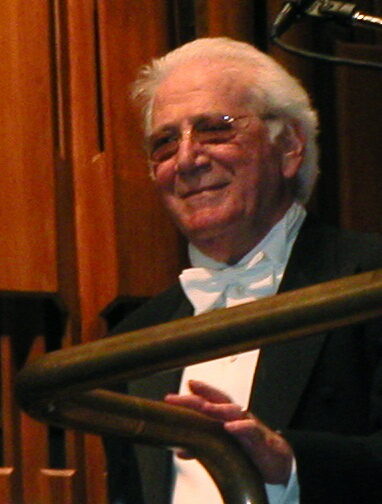
Jerry Goldsmith
Jerry Goldsmith was an American film composer. Born February 10, 1929, in Los Angeles. Died July 21, 2004, in Beverly Hills. Educated at University of Southern California and USC Thornton School of Music. Awards include Primetime Emmy Award for Outstanding Original Main Title Theme Music, Academy Award for Best Original Score and Golden Raspberry Award for Worst Original Song.
Facts
32 facts · 2 confirmed by two sources · 13 cited · 17 from one source
Where this comes from
Papalocal keeps its own record. It started from these sources; what each one said is kept here as it was copied, so a change on their side never changes this page by itself. Tap one to read its version.
What Wikidata says · copied November 13, 2026 · revision 2563758717
- Described as
- American film composer (1929–2004)
- Other names
- Jerrald King Goldsmith
- Born
- February 10, 1929 · 2 references
- Died
- July 21, 2004 · 8 references
- Born in
- Los Angeles · 2 references
- Died in
- Beverly Hills · 1 reference
- Buried in
- Hillside Memorial Park
- Cause of death
- colorectal cancer
- Name at birth
- Jerrald King Goldsmith
- Citizen of
- United States
- Occupation
- conductor · 1 reference; composer · 2 references; film score composer; musician · 1 reference; bandleader · 1 reference
- Education
- University of Southern California; USC Thornton School of Music
- Genre
- classical music · 1 reference; contemporary classical music
- Record label
- Monument Records
- Awards
- Primetime Emmy Award for Outstanding Original Main Title Theme Music; Academy Award for Best Original Score (1977) · 1 reference; Golden Raspberry Award for Worst Original Song (1986) · 1 reference; star on Hollywood Walk of Fame · 1 reference
- Field
- film score
- Spouse
- Carol Heather Goldsmith · 1 reference; Sharon Hennagin Goldsmith (1950–) · 1 reference
- Children
- Joel Goldsmith; Aaron Goldsmith · 1 reference; Carrie Goldsmith · 1 reference; Jennifer Goldsmith · 1 reference; Ellen Goldsmith Edson · 1 reference
- Father
- Morris Goldsmith
- Website
- http://www.jerrygoldsmithonline.com
- Wikipedias with a page
- 58
Wikidata item Q235077 (wikidata.org/wiki/Q235077), public domain (CC0). Copied November 13, 2026.
What Wikipedia says · copied November 13, 2026 · revision 1381814205
Jerrald King Goldsmith (February 10, 1929 – July 21, 2004) was an American composer, conductor and orchestrator with a career in film and television scoring that spanned 49 years and over 200 productions, between 1954 and 2003. He was considered one of film music's most innovative and influential composers. He was nominated for eighteen Academy Awards (winning in 1977 for The Omen), six Grammy Awards, five Primetime Emmy Awards, nine Golden Globe Awards, and four British Academy Film Awards.
He composed scores for five films in the Star Trek franchise, three in The Omen franchise, and three in the Rambo franchise, as well as for films including Planet of the Apes, Patton, Tora! Tora! Tora!, Papillon, Chinatown, Logan's Run, Alien, Poltergeist, The Secret of NIMH, Gremlins, Hoosiers, Total Recall, Sleeping with the Enemy, Medicine Man, Basic Instinct, Rudy, L.A. Confidential, Air Force One, Mulan and The Mummy. He also composed the current fanfare for the Universal Pictures logo, which debuted in The Lost World: Jurassic Park. His scores for the 1960s American television series Thriller, hosted by Boris Karloff, have been pointed out for praise.
He frequently collaborated with directors including Paul Verhoeven, Franklin J. Schaffner, Richard Fleischer, Fred Schepisi, Michael Crichton, Jack Smight, Gordon Douglas, J. Lee Thompson, Paul Wendkos, John Frankenheimer, and Joe Dante.
- Born, in its opening lines
- February 10, 1929
- Died, in its opening lines
- July 21, 2004
From the Wikipedia article “Jerry Goldsmith” (en.wikipedia.org/wiki/Jerry_Goldsmith), by its contributors, under CC BY-SA 4.0 (creativecommons.org/licenses/by-sa/4.0/). Copied November 13, 2026; not changed.
Confirmed Two sources agree. Cited One source, and it names where it got it. One source One source, without a reference of its own. Sources disagree The sources disagree. We show the best-supported value and keep theirs below.
