
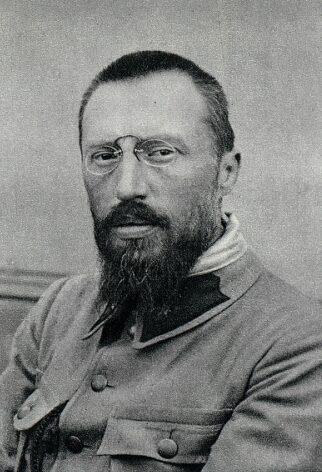
Jerzy Żuławski
Jerzy Żuławski was a Polish philosopher, writer, poet and playwright of the Young Poland period. Born July 14, 1874, in Glinik, Podkarpackie Voivodeship. Died August 9, 1915, in Dębica. Known for Trylogia Księżycowa. Awards include Cross of Independence.
Facts
20 facts · 2 confirmed by two sources · 8 cited · 10 from one source
Where this comes from
Papalocal keeps its own record. It started from these sources; what each one said is kept here as it was copied, so a change on their side never changes this page by itself. Tap one to read its version.
What Wikidata says · copied November 18, 2026 · revision 2567635500
- Described as
- Polish philosopher, writer, poet and playwright of the Young Poland period (1874–1915)
- Born
- July 14, 1874 · 5 references
- Died
- August 9, 1915 · 5 references
- Born in
- Glinik, Podkarpackie Voivodeship
- Died in
- Dębica · 1 reference
- Cause of death
- typhus
- Citizen of
- Austria–Hungary
- Occupation
- poet; translator; philosopher; science fiction writer; writer · 1 reference; mountaineer · 1 reference
- Known for
- Trylogia Księżycowa
- Awards
- Cross of Independence · 1 reference
- Spouse
- Helena Żuławska · 1 reference; Kazimiera Żuławska
- Children
- Wawrzyniec Żuławski · 2 references; Marek Żuławski · 2 references; Juliusz Żuławski · 2 references
- Siblings
- Zygmunt Żuławski · 1 reference
- Wikipedias with a page
- 20
Wikidata item Q1373117 (wikidata.org/wiki/Q1373117), public domain (CC0). Copied November 18, 2026.
What Wikipedia says · copied November 18, 2026 · revision 1386003888
Jerzy Żuławski (Polish: [ˈjɛʐɨ ʐuˈwafski]; 14 July 1874 – 9 August 1915) was a Polish philosopher and writer. He is best known for writing the pioneering science-fiction epic The Lunar Trilogy (1903–1911).
Born into a patriotic family in the village of Lipowiec in Austrian Galicia, he studied engineering briefly at the Zurich Polytechnic before pursuing philosophy at the University of Bern under the empirio-criticist Richard Avenarius. In 1898 he received his doctorate for the dissertation "Das Problem der Kausalität bei Spinoza" (published 1899), later expanded into the popular Polish philosophy study Benedict Spinoza. Man and His Work (1902). He also engaged deeply with Nietzsche, Schopenhauer, Eduard von Hartmann, the Bible, the Talmud, and Eastern thought. These influences shaped his own philosophy of "synthetic monism", which held that Being is simultaneously material and spiritual; the Absolute and an ongoing process. He was concerned with the future of culture, the role of the creative individual, and the dangers of a materially satisfied but spiritually stagnant society.
After a short period as a secondary-school teacher, he devoted himself fully to literature from around 1902. He belonged to the Kraków Young Poland circle, was close to Stanisław Przybyszewski, Jan Kasprowicz, Lucjan Rydel, and Kazimierz Przerwa-Tetmajer; he also had his portrait painted by Stanisław Wyspiański. From 1910 he lived mainly in Zakopane, where he co-founded the Tatra Volunteer Search and Rescue and kept an open literary house.
Żuławski wrote The Lunar Trilogy between 1901 and 1911. Combining scientific romance with philosophical and anthropological inquiry, the trilogy explores the genesis of religion and myth, the cyclical nature of civilization, and the persistence of human flaws. It is regarded as a foundational work of Eastern European and Polish science fiction and strongly influenced Stanisław Lem. The first volume contains one of the earliest literary depictions of an electrically powered lunar rover; this concept later inspired Polish engineer Mieczysław G. Bekker in his work on the Apollo Lunar Roving Vehicles. In the third volume Żuławski anticipated the idea of an nuclear weapon—a weapon that would split the atom and destroy cities or continents—several years before H. G. Wells' The World Set Free (1914). The trilogy was adapted into the 1988 cult film On the Silver Globe by Żuławski's grand-nephew, director Andrzej Żuławski.
At the outbreak of the First World War, Żuławski joined Piłsudski's Polish Legions, served as an officer and editor of the Legion newspaper Do Broni, and died of typhus in a field hospital in Dębica at the age of 41.
- Born, in its opening lines
- July 14, 1874
- Died, in its opening lines
- August 9, 1915
From the Wikipedia article “Jerzy Żuławski” (en.wikipedia.org/wiki/Jerzy_Żuławski), by its contributors, under CC BY-SA 4.0 (creativecommons.org/licenses/by-sa/4.0/). Copied November 18, 2026; not changed.
Confirmed Two sources agree. Cited One source, and it names where it got it. One source One source, without a reference of its own. Sources disagree The sources disagree. We show the best-supported value and keep theirs below.
