
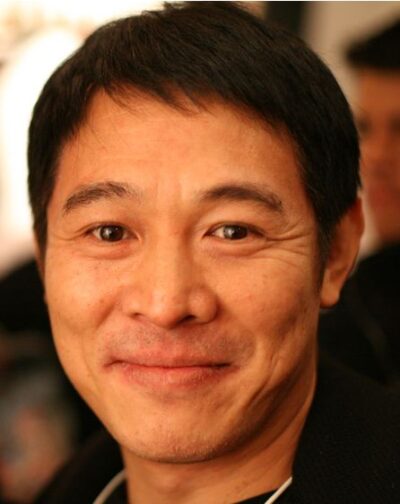
Jet Li
Jet Li is a Chinese-Singaporean martial artist and actor. Born April 26, 1963, in Beijing.
Facts
23 facts · 1 confirmed by two sources · 3 cited · 19 from one source
Where this comes from
Papalocal keeps its own record. It started from these sources; what each one said is kept here as it was copied, so a change on their side never changes this page by itself. Tap one to read its version.
What Wikidata says · copied November 16, 2026 · revision 2569997143
- Described as
- Chinese-Singaporean martial artist and actor
- Other names
- Li Lianjie, Li Yangzhong
- Born
- April 26, 1963 · 5 references
- Born in
- Beijing · 1 reference
- Citizen of
- Singapore (2009–); United States (2003–2009); People's Republic of China (–2003)
- Occupation
- actor; film producer · 1 reference; writer; film director; athlete; film actor · 1 reference
- Sport
- Changquan · 1 reference; dao · 1 reference; wushu · 1 reference
- Genre
- action film; drama fiction; martial arts film
- Instrument
- voice
- Spouse
- Nina Li (1999–); Huang Qiuyan (1987–1990)
- Children
- Jane Li
- Religion
- Buddhism; Tibetan Buddhism · 1 reference
- Wikipedias with a page
- 120
Wikidata item Q159577 (wikidata.org/wiki/Q159577), public domain (CC0). Copied November 16, 2026.
What Wikipedia says · copied November 16, 2026 · revision 1381206139
Jet Li Lianjie (courtesy name Yangzhong; born 26 April 1963) is a martial artist, actor, and philanthropist. With a career spanning more than forty years, he is widely regarded as one of the most influential martial artists in cinema history. Li's early work in mainland China during the 1980s is credited with introducing the Shaolin Temple to a global audience. During the 1990s, his collaborations with filmmaker Tsui Hark spearheaded wushu representation in Hong Kong action cinema, establishing him as its most prominent practitioner. He simultaneously popularised the wuxia genre before transitioning to Hollywood in the late 1990s. His crossover success brought global recognition, solidifying his place alongside Jackie Chan as one of the two biggest names in contemporary martial arts cinema.
Li began his career as a competitive martial artist. Trained as a wushu athlete at the Beijing Shichahai Sports School, he won multiple national championships with the Beijing Wushu Team from 1974 to 1979 under the guidance of coach Wu Bin. After retiring from competitive wushu in 1979, he made his feature film debut in Shaolin Temple (1982), a runaway success followed by two sequels (1984 and 1986). Li established himself as a leading Asian action star by portraying folk hero Wong Fei-hung in director Tsui Hark's critically acclaimed Once Upon a Time in China series (1991–1993). Following his directorial debut with Born to Defence (1988), he anchored a string of other highly successful 1990s projects; these included the wuxia epics Swordsman II (1992) and Fong Sai-yuk (1993), followed by the martial arts films Tai Chi Master (1993) and Fist of Legend (1994). He then successfully reinvented his screen image with a series of popular gun fu action films, including High Risk (1995), Black Mask (1996), and Hitman (1998).
Li made his Hollywood transition as the antagonist in Lethal Weapon 4 (1998), leading to a prolific international career featuring starring roles in Romeo Must Die (2000) and the Luc Besson-produced films Kiss of the Dragon (2001) and Unleashed (2005). He returned to Asian cinema for Zhang Yimou's Academy Award-nominated Hero (2002) and Fearless (2006), followed by The Warlords (2007), which earned him the Hong Kong Film Award for Best Actor. In 2008, he starred in The Mummy: Tomb of the Dragon Emperor and joined fellow martial arts star Jackie Chan in The Forbidden Kingdom, which marked their landmark first on-screen collaboration. He teamed up with Jason Statham in five films: The One (2001), War (2007), and the first three installments of
The Expendables (2010–2014). He then made a high-profile return to the screen in Yuen Woo-ping's 2026 epic Blades of the Guardians, which became the highest-grossing wuxia film of all time worldwide.
As a philanthropist, Li founded One Foundation in 2007, which was registered in 2011 as the first private charitable fundraising organization in China. He also co-founded Taiji Zen, an online health program providing instruction in meditation and tai chi. Li topped Forbes's list of China's richest stars in 2004. He was named by Time magazine as one of the 100 most influential people in 2010.
- Born, in its opening lines
- April 26, 1963
From the Wikipedia article “Jet Li” (en.wikipedia.org/wiki/Jet_Li), by its contributors, under CC BY-SA 4.0 (creativecommons.org/licenses/by-sa/4.0/). Copied November 16, 2026; not changed.
Confirmed Two sources agree. Cited One source, and it names where it got it. One source One source, without a reference of its own. Sources disagree The sources disagree. We show the best-supported value and keep theirs below.
