
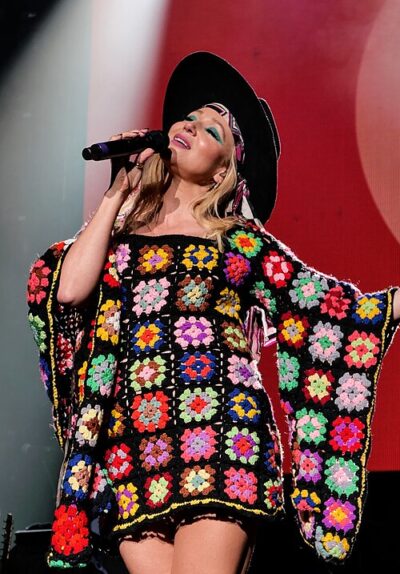
Jewel
Jewel is an American singer-songwriter. Born May 23, 1974, in Payson. Educated at Interlochen Center for the Arts and Steller Secondary School. Awards include MTV Video Music Award for Best Female Video.
Facts
35 facts · 1 confirmed by two sources · 14 cited · 20 from one source
Where this comes from
Papalocal keeps its own record. It started from these sources; what each one said is kept here as it was copied, so a change on their side never changes this page by itself. Tap one to read its version.
What Wikidata says · copied November 13, 2026 · revision 2568549676
- Described as
- American singer-songwriter
- Other names
- Jewel Kilcher
- Born
- May 23, 1974 · 2 references
- Born in
- Payson
- Name at birth
- Jewel Kilcher
- Citizen of
- United States
- Occupation
- singer-songwriter; singer · 1 reference; actor; songwriter · 1 reference; yodeler; guitarist · 1 reference; film actor; poet
- Education
- Interlochen Center for the Arts (1990–1992) · 1 reference; Steller Secondary School · 1 reference
- Genre
- pop music; country music · 1 reference; folk music
- Instrument
- guitar; voice
- Record label
- Big Machine Records (2007–) · 1 reference; Atlantic Records (1994–) · 1 reference
- Awards
- MTV Video Music Award for Best Female Video (1997)
- Field
- music composing; music · 1 reference; singing · 1 reference; guitar performance · 1 reference; poetry · 1 reference; acting · 1 reference
- Spouse
- Ty Murray (2008–2014) · 2 references
- Children
- Kase Townes Murray · 1 reference
- Father
- Attila Kuno Kilcher
- Mother
- Lenedra Carroll
- Siblings
- Atz Lee Kilcher
- Lived in
- Telluride (2020) · 1 reference
- Website
- https://jeweljk.com/
- Wikipedias with a page
- 44
Wikidata item Q229018 (wikidata.org/wiki/Q229018), public domain (CC0). Copied November 13, 2026.
What Wikipedia says · copied November 13, 2026 · revision 1380122910
Jewel Kilcher (born May 23, 1974) is an American singer-songwriter. She has been nominated for four Grammy Awards and has sold over 30 million albums worldwide as of 2024.
Jewel was raised near Homer, Alaska, where she grew up singing and yodeling as a musical duo with her father, Atz Kilcher, a local musician. At age fifteen, she received a partial scholarship to the Interlochen Arts Academy in Michigan, where she studied operatic voice. After graduating, she began writing and performing at clubs and coffeehouses in San Diego, California. Based on local media attention, she was signed by Atlantic Records in 1993, which released her debut album Pieces of You two years later. One of the best-selling debut albums of all time, it went 12-times platinum. The debut single from the album, "Who Will Save Your Soul", peaked at number 11 on the Billboard Hot 100. Singles "You Were Meant for Me" and "Foolish Games" reached number two on the Hot 100, and were listed on Billboard's 1997 year-end singles chart, as well as Billboard's 1998 year-end singles chart.
Jewel's second effort, Spirit, was released in 1998, followed by This Way (2001). In 2003, she released 0304, which marked a departure from her previous folk-oriented records, featuring electronic arrangements and elements of dance-pop. In 2008, she released Perfectly Clear, her first country album, which debuted atop Billboard's Top Country Albums chart and featured three singles, "Stronger Woman", "I Do", and "'Til It Feels Like Cheating". In 2009, Jewel released her first independent album, Lullaby.
In 1998, Jewel released a collection of poetry, and in the following year, she appeared in a supporting role in Ang Lee's Western film Ride with the Devil (1999) which earned her critical acclaim. In 2021, she won the sixth season of The Masked Singer as the Queen of Hearts.
- Born, in its opening lines
- May 23, 1974
From the Wikipedia article “Jewel (singer)” (en.wikipedia.org/wiki/Jewel_(singer)), by its contributors, under CC BY-SA 4.0 (creativecommons.org/licenses/by-sa/4.0/). Copied November 13, 2026; not changed.
Confirmed Two sources agree. Cited One source, and it names where it got it. One source One source, without a reference of its own. Sources disagree The sources disagree. We show the best-supported value and keep theirs below.
