
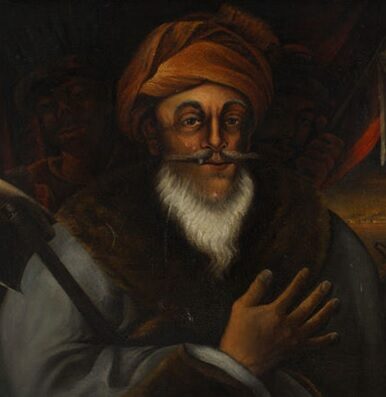
Jezzar Pasha was the 18th-century Ottoman governor. Born 1722, in Stolac. Died April 23, 1804, in Damascus. Positions held include Beylerbey of Sidon and Beylerbey of Damascus.
Facts
10 facts · 0 confirmed by two sources · 1 cited · 9 from one source
Where this comes from
Papalocal keeps its own record. It started from these sources; what each one said is kept here as it was copied, so a change on their side never changes this page by itself. Tap one to read its version.
What Wikidata says · copied November 18, 2026 · revision 2554210865
- Described as
- 18th-century Ottoman governor
- Other names
- Djezzar
- Born
- 1722
- Died
- April 23, 1804 · 1 reference
- Born in
- Stolac
- Died in
- Damascus
- Buried in
- Acre
- Citizen of
- Ottoman Empire
- Occupation
- military leader
- Positions held
- Beylerbey of Sidon; Beylerbey of Damascus
- Religion
- Islam
- Wikipedias with a page
- 22
Wikidata item Q2453214 (wikidata.org/wiki/Q2453214), public domain (CC0). Copied November 18, 2026.
What Wikipedia says · copied November 18, 2026 · revision 1384952692
Ahmed Pasha al-Jazzar (Arabic: أحمد باشا الجزّار, c. 1720–30s – 7 May 1804) was the Acre-based Ottoman governor of Sidon Eyalet from 1776 until his death in 1804 and the simultaneous governor of Damascus Eyalet in 1785–1786, 1790–1795, 1798–1799, and 1803–1804. Having left his native Bosnia as a youth, he began a military career in Egypt in the service of mamluk officials, eventually becoming a chief enforcer for Ali Bey al-Kabir, Egypt's strongman ruler. Al-Jazzar fell out with Ali Bey in 1768 after refusing to take part in the assassination of another of his former masters. He fled to Syria, where he was tasked by the Ottomans with defending Beirut from a joint assault by the Russian Navy and Daher al-Umar, the Acre-based ruler of northern Palestine. He eventually surrendered and entered Daher's service before defecting from him.
After the Ottomans eliminated Daher, they appointed al-Jazzar as their garrison commander in Acre. He pacified the Galilee and Mount Lebanon, which had been dominated by Daher's kinsmen and the Druze forces of Yusuf Shihab, respectively. In 1776, he was appointed governor of Sidon with his capital at Acre, which he strongly fortified. In the following years, he defeated his erstwhile Shia Muslim ally, Nasif al-Nassar, consolidating his control over Jabal Amil (southern Lebanon). In 1785, al-Jazzar was appointed to his first of four terms as governor of Damascus, each time gaining more influence in the province's affairs in opposition to his rivals from the Azm family. In 1799, with the help of the British navy, al-Jazzar defended Acre from Napoleon, forcing the latter to withdraw from Palestine in disarray. His successful defense of Acre earned him prestige in the empire and made him well known in Europe.
Al-Jazzar died in office in 1804. He was ultimately succeeded in Acre by his mamluk Sulayman Pasha al-Adil; until his suppression of a mamluk revolt in 1789, al-Jazzar had appointed mamluks to senior posts in his military and administration. Al-Jazzar attempted to develop the areas under his control by improving road security and maintaining order. However, his domestic military expeditions and stringently enforced and exploitative taxation policies precipitated high emigration, although the cities of Acre and Beirut prospered. The former became a powerful regional center rivaling Damascus and until today contains many architectural works commissioned by al-Jazzar, such as its walls, the el-Jazzar Mosque and the Khan al-Umdan caravanserai.
From the Wikipedia article “Jazzar Pasha” (en.wikipedia.org/wiki/Jazzar_Pasha), by its contributors, under CC BY-SA 4.0 (creativecommons.org/licenses/by-sa/4.0/). Copied November 18, 2026; not changed.
Confirmed Two sources agree. Cited One source, and it names where it got it. One source One source, without a reference of its own. Sources disagree The sources disagree. We show the best-supported value and keep theirs below.
