
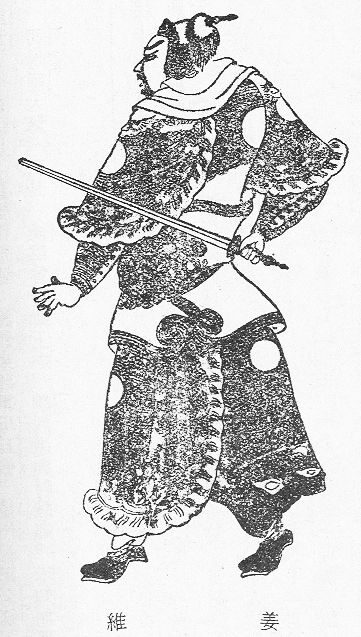
Jiang Wei was a Chinese Shu Han state general. Born 202, in Gangu County. Died March 3, 264, in Chengdu.
Facts
6 facts · 2 confirmed by two sources · 1 cited · 3 from one source
Where this comes from
Papalocal keeps its own record. It started from these sources; what each one said is kept here as it was copied, so a change on their side never changes this page by itself. Tap one to read its version.
What Wikidata says · copied November 18, 2026 · revision 2553946527
- Described as
- Chinese Shu Han state general (202-264)
- Other names
- Jiang Boyue
- Born
- 202
- Died
- March 3, 264
- Born in
- Gangu County
- Died in
- Chengdu
- Citizen of
- Shu Han · 1 reference
- Occupation
- politician
- Wikipedias with a page
- 24
Wikidata item Q280866 (wikidata.org/wiki/Q280866), public domain (CC0). Copied November 18, 2026.
What Wikipedia says · copied November 18, 2026 · revision 1383034091
Jiang Wei (202 – 3 March 264), courtesy name Boyue, was a Chinese military general and politician
of the state of Shu Han during the Three Kingdoms period of China.
Born in Ji County (present-day Gangu County, Gansu), Jiang Wei started his career as a military officer in his native Tianshui Commandery, which was a territory of Wei. In 228, when Wei's rival state Shu launched an invasion led by Zhuge Liang, Jiang Wei was distrusted by Ma Zun, then administrator of Tianshui Commandery. As such, Jiang Wei had to defect to Shu. Zhuge Liang, the Imperial Chancellor and regent of Shu, highly regarded Jiang Wei and appointed him as a general in Shu. After Zhuge Liang's death in 234, Jiang Wei continued serving as a military commander during the regencies Jiang Wan and Fei Yi, eventually rising to the highest military rank of General-In-Chief (大將軍) after Fei Yi's death in 253. Between 240 and 262, he continued Zhuge Liang's legacy of waging war against Wei by leading another 11 military campaigns. However, Jiang Wei's campaigns were relatively constrained in terms of both scale and duration due to Shu's limited resources and inadequate food supplies, as well as internal political faultlines. In 263, when Wei launched a massive invasion of Shu, Jiang Wei led Shu forces to resist the invaders at Tazhong, Yinping and Jiange, himself defending Jiange which was under Zhong Hui's attack. While Jiang Wei managed to temporarily stall Wei's main force led by Zhong Hui, Deng Ai, another military commander of Wei, took a shortcut via Yinping and showed up at Chengdu unexpectedly. Liu Shan surrendered to Deng Ai without putting up resistance and ordered Jiang Wei to surrender to the Wei general Zhong Hui; this event marked the end of Shu's existence. In the following year, Jiang Wei instigated Zhong Hui to launch a rebellion in Chengdu against the Wei regent Sima Zhao and hoped to use the opportunity to gain military power and restore Shu. However, some of Zhong Hui's officers were unwilling to participate in the rebellion and started a mutiny, killing Jiang Wei and Zhong Hui.
- Born, in its opening lines
- 202
- Died, in its opening lines
- March 3, 264
From the Wikipedia article “Jiang Wei” (en.wikipedia.org/wiki/Jiang_Wei), by its contributors, under CC BY-SA 4.0 (creativecommons.org/licenses/by-sa/4.0/). Copied November 18, 2026; not changed.
Confirmed Two sources agree. Cited One source, and it names where it got it. One source One source, without a reference of its own. Sources disagree The sources disagree. We show the best-supported value and keep theirs below.
