
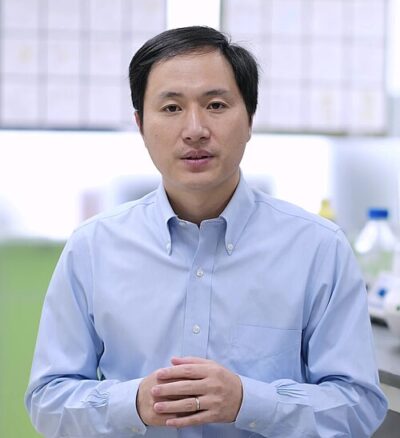
Jiankui He
Jiankui He is a Chinese biophysicist. Born 1984, in Xinhua County. Educated at University of Science and Technology of China and Rice University. Awards include Thousand Talents Program and Nature's 10.
Facts
17 facts · 0 confirmed by two sources · 3 cited · 14 from one source
Where this comes from
Papalocal keeps its own record. It started from these sources; what each one said is kept here as it was copied, so a change on their side never changes this page by itself. Tap one to read its version.
What Wikidata says · copied November 16, 2026 · revision 2560712507
- Described as
- Chinese biophysicist (1984-)
- Other names
- He Jiankui
- Born
- 1984 · 1 reference
- Born in
- Xinhua County
- Citizen of
- People's Republic of China
- Occupation
- biomedical engineer; physicist · 1 reference; geneticist · 1 reference; inventor
- Worked for
- Southern University of Science and Technology (2012–2018)
- Education
- University of Science and Technology of China (2002–2006); Rice University (2009–2010); Stanford University (2011–2012)
- Awards
- Thousand Talents Program; Nature's 10 (2018) · 1 reference
- Field
- biophysics · 1 reference; genetic engineering · 1 reference; CRISPR-Cas method · 1 reference
- Spouse
- Cathy Tie
- Wikipedias with a page
- 32
Wikidata item Q59223278 (wikidata.org/wiki/Q59223278), public domain (CC0). Copied November 16, 2026.
What Wikipedia says · copied November 16, 2026 · revision 1382101177
He Jiankui (Chinese: 贺建奎; pinyin: Hè Jiànkuí [xɤ̂ tɕjɛ̂nkʰwěɪ] HUH JEE-enn KWAY; born 1984) is a Chinese biophysicist known for his controversial first use of genome editing in humans in 2018. He was listed as one of Time's 100 most influential people of 2019, in the section "Pioneers". At the same time, he was widely condemned as a mad scientist.
He served as associate professor of biology at the Southern University of Science and Technology (SUSTech) in Shenzhen, Guangdong, China, before his dismissal from the university in January 2019. In November 2018, He announced that he had created the first human genetically edited babies, twin girls who were born modified with HIV resistance in October 2018 and were known by their pseudonyms, Lulu and Nana. The announcement was initially praised in the press as a major scientific advancement. However, following scrutiny on how the experiment was executed, he received widespread condemnation from the public and scientific community. An investigation report showed that he raised money for his research to evade government and university research regulations.
His research activities were suspended by the Chinese authorities on 29 November 2018, and he was fired by SUSTech on 21 January 2019. On 30 December 2019, a Chinese district court found He Jiankui guilty of illegal practice of medicine (equivalent to the crime of "practicing medicine without a license" in many other jurisdictions), sentencing him to three years in prison with a fine of 3 million yuan. He was released from prison in April 2022.
In February 2023, his application for a Hong Kong work visa was granted but was soon revoked after the Hong Kong Immigration Department launched a criminal investigation against him for making false statements in his application. In September 2023, He was recruited by the Wuchang University of Technology, a private college in Wuhan, Hubei, to serve as the inaugural director for the school's Genetic Medicine Institute.
From the Wikipedia article “He Jiankui” (en.wikipedia.org/wiki/He_Jiankui), by its contributors, under CC BY-SA 4.0 (creativecommons.org/licenses/by-sa/4.0/). Copied November 16, 2026; not changed.
Confirmed Two sources agree. Cited One source, and it names where it got it. One source One source, without a reference of its own. Sources disagree The sources disagree. We show the best-supported value and keep theirs below.
