
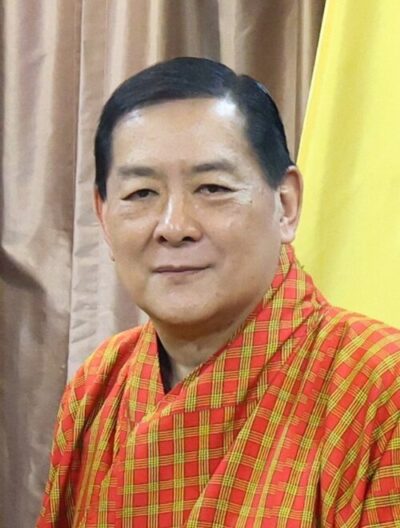
Jigme Singye Wangchuck
Jigme Singye Wangchuck is a King of Bhutan from 1972–2006. Born November 11, 1955, in Dechencholing Palace. Positions held include King of Bhutan (1972–2006). Educated at Heatherdown Preparatory School and St. Joseph's School, Darjeeling. Awards include Champions of the Earth, J. Paul Getty Award for Conservation Leadership and Collar of the Supreme Order of the Chrysanthemum.
Facts
28 facts · 1 confirmed by two sources · 2 cited · 25 from one source
Where this comes from
Papalocal keeps its own record. It started from these sources; what each one said is kept here as it was copied, so a change on their side never changes this page by itself. Tap one to read its version.
What Wikidata says · copied November 16, 2026 · revision 2560033614
- Described as
- King of Bhutan from 1972–2006
- Born
- November 11, 1955 · 1 reference
- Born in
- Dechencholing Palace
- Citizen of
- Bhutan
- Occupation
- sovereign
- Positions held
- King of Bhutan (1972–2006) · 1 reference
- Education
- Heatherdown Preparatory School; St. Joseph's School, Darjeeling
- Awards
- Champions of the Earth (2005); J. Paul Getty Award for Conservation Leadership (2006) · 1 reference; Collar of the Supreme Order of the Chrysanthemum; Blue Planet Prize (2022) · 1 reference
- Spouse
- Dorji Wangmo (1979–); Tshering Yangdon (1979–) · 1 reference; Tshering Pem (1979–) · 1 reference; Sangay Choden (1979–)
- Children
- Jigme Khesar Namgyel Wangchuck; Jigyel Ugyen Wangchuck · 1 reference; Jigme Dorji Wangchuck · 1 reference; Ugyen Jigme Wangchuck · 1 reference; Kesang Choden Wangchuck · 1 reference; Princess Sonam Dechen Wangchuck of Bhutan · 1 reference; Chimi Yangzom Wangchuck · 1 reference; Khamsum Singye Wangchuck; Dechen Yangzom Wangchuck; Euphelma Choden Wangchuck
- Father
- Jigme Dorji Wangchuck
- Mother
- Kesang Choden Wangchuk
- Religion
- Buddhism
- Wikipedias with a page
- 60
Wikidata item Q200273 (wikidata.org/wiki/Q200273), public domain (CC0). Copied November 16, 2026.
What Wikipedia says · copied November 16, 2026 · revision 1385015134
Jigme Singye Wangchuck (Dzongkha: འཇིགས་མེད་སེང་གེ་དབང་ཕྱུག་, Wylie: jigs med seng ge dbang phyug; born 11 November 1955) is a member of the Wangchuck dynasty who reigned as King of Bhutan from 1972 until his abdication in 2006. He is the father of the present King Jigme Khesar Namgyel Wangchuck. He is the only son of five children born to the King Jigme Dorji Wangchuck and Queen Ashi Kesang Choden.
Jigme Singye Wangchuck studied at St. Joseph's School, Darjeeling, in India. In January 1965, he attended Summerfields prep school in St. Leonards-on-Sea, Sussex, England, and then Heatherdown School in 1966 where he completed his studies in 1969. After completion of his studies in 1970, he was appointed as the chairman of the National Planning Commission in the year 1971 by King Jigme Dorji Wangchuck. At the age of 16, he was appointed as the Trongsa Penlop and bestowed with saffron scarf.
On 21 July 1972, King Jigme Dorji died in Kenya, and the 16-year-old Crown Prince Jigme Singye Wangchuck ascended the throne, becoming the world's youngest monarch at the time. Just three days after his father's death, the Crown Prince assumed leadership of the government and the nation. His coronation ceremony was later held on June 2, 1974, in Thimphu.
During his reign, Bhutan transitioned from an absolute monarchy to a democratic constitutional monarchy. This progress towards a democratic constitutional monarchy started with decentralization of power to people on the grass root level. He initiated Dzongkhag Yargye Tshogdu (DYT) in 1981 and the Gewog Yargye Tshogchung (GYT) in 1991 in order to ensure people's participation and local governance. In 2001, a Constitution Drafting Committee was established under royal decree. The King personally presented the Constitution of Bhutan to citizens across all 20 Dzongkhags, with every word considered meaningful and sanctified by the people. It was introduced as "the People's Constitution," symbolizing its alignment with the aspirations of the Bhutanese people. The Constitution of Bhutan was enacted July 18, 2008 by the Royal Government.
He introduced the Gross National Happiness (GNH) philosophy in the early 1970s, emphasizing holistic development over purely economic growth. In 2003, he personally led Operation All Clear, a military campaign to expel insurgent groups from southern Bhutan, marking an unusual instance of a head of state leading troops into action. After 34 years of rule, he voluntarily abdicated in 2006 at 51 years old, overseeing a peaceful transition to democracy through a transparent constitutional process.
Throughout his reign, Jigme Singye Wangchuck implemented various socio-economic policies to enhance the quality of life in Bhutan. He emphasized the need to develop industry, agriculture, hydroelectricity, and infrastructural projects while prioritizing environmental and cultural preservation. The success of these policies can be seen in indicators such as increased access to education and healthcare, improvements in infrastructure, and the promotion of Bhutan's unique cultural heritage.
He was also responsible for the development of new policies in the environment and improved access to education and healthcare.
- Born, in its opening lines
- November 11, 1955
From the Wikipedia article “Jigme Singye Wangchuck” (en.wikipedia.org/wiki/Jigme_Singye_Wangchuck), by its contributors, under CC BY-SA 4.0 (creativecommons.org/licenses/by-sa/4.0/). Copied November 16, 2026; not changed.
Confirmed Two sources agree. Cited One source, and it names where it got it. One source One source, without a reference of its own. Sources disagree The sources disagree. We show the best-supported value and keep theirs below.
