
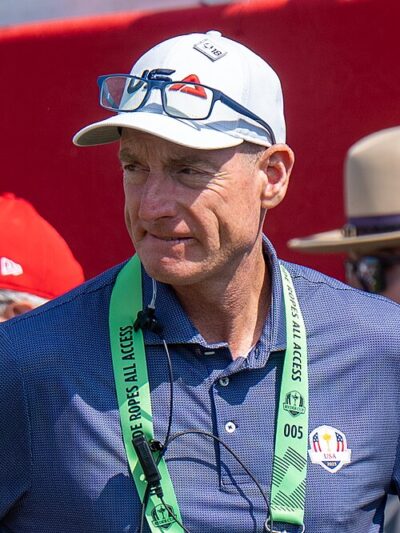
Jim Furyk is an American professional golfer. Born May 12, 1970, in West Chester. Teams include Arizona Wildcats men's golf. Educated at Manheim Township High School and Eller College of Management.
Facts
10 facts · 1 confirmed by two sources · 0 cited · 9 from one source
Where this comes from
Papalocal keeps its own record. It started from these sources; what each one said is kept here as it was copied, so a change on their side never changes this page by itself. Tap one to read its version.
What Wikidata says · copied November 18, 2026 · revision 2548646340
- Described as
- American professional golfer
- Born
- May 12, 1970 · 1 reference
- Born in
- West Chester
- Citizen of
- United States
- Occupation
- golfer (1992–)
- Education
- Manheim Township High School · 1 reference; Eller College of Management
- Teams
- Arizona Wildcats men's golf · 1 reference
- Sport
- golf
- Height
- 1.88 m (6 ft 2 in)
- Website
- http://www.jimfuryk.com
- Wikipedias with a page
- 17
Wikidata item Q690638 (wikidata.org/wiki/Q690638), public domain (CC0). Copied November 18, 2026.
What Wikipedia says · copied November 18, 2026 · revision 1383141569
James Michael Furyk (born May 12, 1970) is an American professional golfer and analyst who plays on the PGA Tour and the PGA Tour Champions. In 2010, he was the FedEx Cup champion and PGA Tour Player of the Year. He has won one major championship, the 2003 U.S. Open. Furyk holds the record for the lowest score in PGA Tour history, a round of 58 which he shot during the final round of the 2016 Travelers Championship, and has earned notoriety for his unorthodox golf swing.
In September 2006 he reached a career high of second in the Official World Golf Ranking. He ranked in the top-10 for over 440 weeks between 1999 and 2016.
- Born, in its opening lines
- May 12, 1970
From the Wikipedia article “Jim Furyk” (en.wikipedia.org/wiki/Jim_Furyk), by its contributors, under CC BY-SA 4.0 (creativecommons.org/licenses/by-sa/4.0/). Copied November 18, 2026; not changed.
Confirmed Two sources agree. Cited One source, and it names where it got it. One source One source, without a reference of its own. Sources disagree The sources disagree. We show the best-supported value and keep theirs below.
