
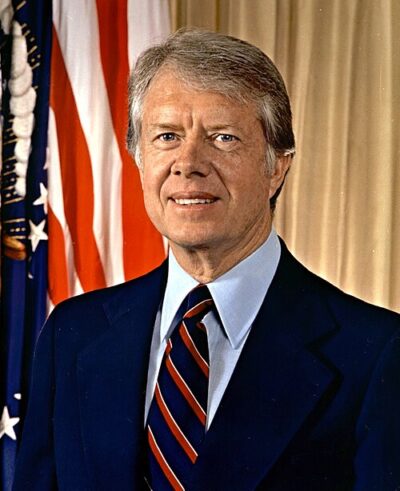
Jimmy Carter
Jimmy Carter was a president of the United States from 1977 to 1981. Born October 1, 1924, in Lillian G. Carter Nursing Center. Died December 29, 2024, in Jimmy Carter House. Positions held include President of the United States (1977–1981), Governor of Georgia (1971–1975) and President-elect of the United States (1976–1977). Educated at Georgia Southwestern State University and Georgia Tech. Awards include Nobel Peace Prize, Presidential Medal of Freedom and United Nations Prize in the Field of Human Rights.



Facts
62 facts · 2 confirmed by two sources · 29 cited · 31 from one source
Where this comes from
Papalocal keeps its own record. It started from these sources; what each one said is kept here as it was copied, so a change on their side never changes this page by itself. Tap one to read its version.
What Wikidata says · copied November 13, 2026 · revision 2567144401
- Described as
- president of the United States from 1977 to 1981 (1924–2024)
- Other names
- James E. Carter, Jr., 39th President of the United States, James Earl Carter, James E. Carter Jr., James Carter, James Earl Carter, Jr., James Earl Carter Jr., James E. Carter
- Born
- October 1, 1924 · 10 references
- Died
- December 29, 2024 · 4 references
- Born in
- Lillian G. Carter Nursing Center · 1 reference
- Died in
- Jimmy Carter House · 1 reference
- Buried in
- Jimmy Carter National Historical Park · 1 reference
- Name at birth
- James Earl Carter Jr.
- Citizen of
- United States
- Occupation
- naval officer; diplomat; novelist; politician · 3 references; farmer; autobiographer; submariner; statesperson
- Positions held
- President of the United States (1977–1981) · 1 reference; Governor of Georgia (1971–1975); President-elect of the United States (1976–1977); member of the Georgia State Senate (1963–1967); president · 1 reference
- Political party
- Democratic Party
- Worked for
- Emory University
- Education
- Georgia Southwestern State University; Georgia Tech; United States Naval Academy (–1946); Union College (1953–)
- Member of
- American Academy of Arts and Sciences; American Legion · 1 reference; Trilateral Commission; The Elders (2007–2016) · 1 reference
- Awards
- Nobel Peace Prize (2002) · 2 references; Presidential Medal of Freedom (1999) · 2 references; United Nations Prize in the Field of Human Rights (1998) · 2 references; Félix Houphouët-Boigny Peace Prize (1994) · 1 reference; Indira Gandhi Peace Prize · 2 references; Four Freedoms Award – Freedom Medal (1995) · 1 reference; Philadelphia Liberty Medal (1990) · 1 reference; American Peace Award (2009) · 1 reference; Delta Prize for Global Understanding (1999) · 1 reference; International Mediation medal (1979) · 1 reference; Ansel Adams Award (1981) · 1 reference; Catalonia International Prize (2010) · 1 reference; J. William Fulbright Prize (1994) · 1 reference; Hoover Medal (1998) · 1 reference; Albert Schweitzer Prize for Humanitarianism (1987) · 1 reference
- Field
- politics · 1 reference
- Spouse
- Rosalynn Carter (1946–2023) · 2 references
- Children
- Jack Carter; Amy Carter; James Earl Carter III · 1 reference; Jeff Carter · 1 reference
- Father
- James Earl Carter Sr. · 1 reference
- Mother
- Lillian Gordy Carter · 1 reference
- Siblings
- Billy Carter; Gloria Carter Spann; Ruth Carter Stapleton
- Religion
- Christianity
- Military branch
- United States Navy
- Military rank
- lieutenant
- Lived in
- Plains · 1 reference; Jimmy Carter House · 1 reference
- Height
- 1.77 m (5 ft 10 in) · 1 reference
- Wikipedias with a page
- 200
Wikidata item Q23685 (wikidata.org/wiki/Q23685), public domain (CC0). Copied November 13, 2026.
What Wikipedia says · copied November 13, 2026 · revision 1384625769
James Earl Carter Jr. (October 1, 1924 – December 29, 2024) was an American politician and humanitarian who served as the 39th president of the United States from 1977 to 1981. A member of the Democratic Party, Carter served as the 76th governor of Georgia from 1971 to 1975 and in the Georgia State Senate from 1963 to 1967. He lived longer than any other president in U.S. history, reaching age 100.
Born in Plains, Georgia, Carter graduated from the U.S. Naval Academy in 1946 and joined the submarine service before returning to his family's peanut farm. He was active in the civil rights movement, then served as a state senator and the 76th governor, one of the first of the "New South governors" committed to desegregation. After announcing his candidacy in 1976, Carter secured the Democratic nomination as a dark horse little known outside his home state before narrowly defeating Republican incumbent Gerald Ford in the general election.
As president, Carter pardoned all Vietnam draft evaders and negotiated major foreign policy agreements, including the Camp David Accords, the Panama Canal Treaties, and the second round of Strategic Arms Limitation Talks, and he established diplomatic relations with China. He created a national energy policy that included conservation, price control, and new technology. He signed bills that created the Departments of Energy and Education. The later years of his presidency were marked by several foreign policy crises, including the Soviet invasion of Afghanistan (leading to the end of détente and the 1980 Olympics boycott) and the fallout of the Iranian Revolution (including the Iran hostage crisis and 1979 oil crisis). Carter sought reelection in 1980, defeating a primary challenge by Senator Ted Kennedy, but lost the election to Republican nominee Ronald Reagan in a landslide.
Polls of historians and political scientists have ranked Carter's presidency below average. His post-presidency—the longest in U.S. history—is viewed more favorably. After Carter's presidential term ended, he established the Carter Center to promote human rights, earning him the 2002 Nobel Peace Prize. He traveled extensively to conduct peace negotiations, monitor elections, and end neglected tropical diseases, becoming a major supporter of the attempted eradication of dracunculiasis. Carter was a key figure in the nonprofit housing organization Habitat for Humanity. He also wrote political memoirs and other books, commentary on the Israeli–Palestinian conflict, and poetry.
- Born, in its opening lines
- October 1, 1924
- Died, in its opening lines
- December 29, 2024
From the Wikipedia article “Jimmy Carter” (en.wikipedia.org/wiki/Jimmy_Carter), by its contributors, under CC BY-SA 4.0 (creativecommons.org/licenses/by-sa/4.0/). Copied November 13, 2026; not changed.
Confirmed Two sources agree. Cited One source, and it names where it got it. One source One source, without a reference of its own. Sources disagree The sources disagree. We show the best-supported value and keep theirs below.
