
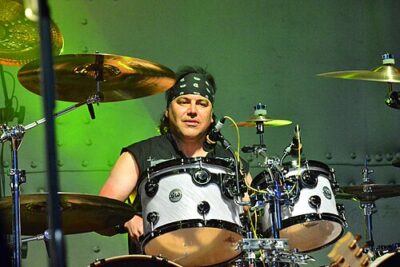
Jimmy DeGrasso
Jimmy DeGrasso is an American drummer. Born March 16, 1963, in Bethlehem. Educated at Liberty High School.
Facts
14 facts · 1 confirmed by two sources · 2 cited · 11 from one source
Where this comes from
Papalocal keeps its own record. It started from these sources; what each one said is kept here as it was copied, so a change on their side never changes this page by itself. Tap one to read its version.
What Wikidata says · copied November 16, 2026 · revision 2529499553
- Described as
- American drummer
- Born
- March 16, 1963 · 1 reference
- Born in
- Bethlehem
- Citizen of
- United States
- Occupation
- drummer; musician; session musician
- Education
- Liberty High School · 1 reference
- Member of
- Megadeth (1998–2002); Black Star Riders; Suicidal Tendencies
- Genre
- hard rock; heavy metal music · 1 reference
- Instrument
- drum kit · 1 reference
- Website
- http://www.jimmydegrasso.com/
- Wikipedias with a page
- 24
Wikidata item Q439752 (wikidata.org/wiki/Q439752), public domain (CC0). Copied November 16, 2026.
What Wikipedia says · copied November 16, 2026 · revision 1367594106
Jimmy DeGrasso (born March 16, 1963) is an American heavy metal drummer.
DeGrasso played with Mama's Boys and Lita Ford before eventually working with Y&T and Megadeth and as a session and touring musician for Ozzy Osbourne (1986), White Lion (1991), Fiona (1992), Suicidal Tendencies (1992–1995), MD.45 (1996), and Alice Cooper (1995–1997).
After Megadeth broke up around 2002, DeGrasso worked with Dave Ellefson's F5 (2007–2010) and toured with The David Lee Roth Band (2006), Ministry (2008), Alice Cooper (2008), Hail (2009), Dokken (2012), and Ratt (2014). He also was the drummer of Black Star Riders from December 2012 until March 2017.
- Born, in its opening lines
- March 16, 1963
From the Wikipedia article “Jimmy DeGrasso” (en.wikipedia.org/wiki/Jimmy_DeGrasso), by its contributors, under CC BY-SA 4.0 (creativecommons.org/licenses/by-sa/4.0/). Copied November 16, 2026; not changed.
Confirmed Two sources agree. Cited One source, and it names where it got it. One source One source, without a reference of its own. Sources disagree The sources disagree. We show the best-supported value and keep theirs below.
