
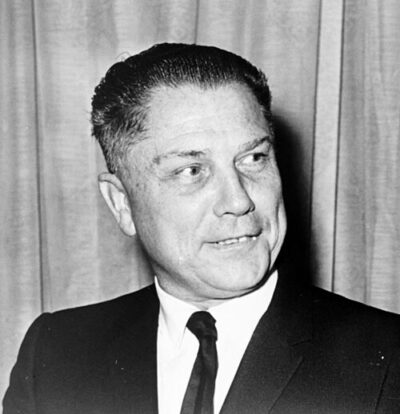
Jimmy Hoffa
Jimmy Hoffa was an American labor union leader. Born February 14, 1913, in Brazil. Died July 30, 1975, in Bloomfield Hills.
Facts
20 facts · 1 confirmed by two sources · 7 cited · 12 from one source
Where this comes from
Papalocal keeps its own record. It started from these sources; what each one said is kept here as it was copied, so a change on their side never changes this page by itself. Tap one to read its version.
What Wikidata says · copied November 14, 2026 · revision 2568752685
- Described as
- American labor union leader (1913 – 1975)
- Other names
- James Riddle Hoffa, James R. Hoffa, James Hoffa
- Born
- February 14, 1913 · 6 references
- Died
- July 30, 1975
- Born in
- Brazil
- Died in
- Bloomfield Hills · 1 reference
- Name at birth
- James Riddle Hoffa
- Citizen of
- United States
- Occupation
- trade unionist; writer · 1 reference; activist; labor leader · 1 reference; functionary · 1 reference; union member · 1 reference
- Member of
- International Brotherhood of Teamsters
- Field
- labor union · 1 reference; organized crime · 1 reference
- Children
- Barbara Ann Crancer; James P. Hoffa
- Lived in
- Indiana; Detroit; Orion Township
- Wikipedias with a page
- 40
Wikidata item Q317638 (wikidata.org/wiki/Q317638), public domain (CC0). Copied November 14, 2026.
What Wikipedia says · copied November 14, 2026 · revision 1383880967
James Riddle Hoffa (born February 14, 1913; disappeared July 30, 1975; declared dead July 30, 1982) was an American labor union leader who served as the General President of the International Brotherhood of Teamsters (IBT) from 1957 to 1971. He was alleged to have ties to organized crime, and he disappeared under mysterious circumstances in 1975.
From an early age, Hoffa was a union activist; he became an important regional figure with the IBT by his mid-20s. By 1952, he was the national vice-president of the IBT and between 1957 and 1971, he served as its general president. Hoffa secured the first national agreement for teamsters' rates in 1964 with the National Master Freight Agreement. He played a major role in the growth and the development of the union, which eventually became the largest by membership in the United States, with over 2.3 million members at its peak, during his terms as its leader.
Hoffa became involved with organized crime from the early years of his Teamsters work: a connection that continued until his disappearance. He was convicted of jury tampering, attempted bribery, and conspiracy, along with mail and wire fraud in 1964 in two separate trials. He was imprisoned in 1967 and sentenced to 13 years.
In mid-1971, Hoffa resigned as president of the union as part of a commutation agreement with U.S. President Richard Nixon and was released later that year, but he was barred from union activities until 1980. Hoping to regain support and to return to IBT leadership, he unsuccessfully tried to overturn the order. Hoffa disappeared on July 30, 1975: he is thought to have been murdered in a Mafia hit and was declared legally dead in 1982. Hoffa's legacy and the circumstances of his disappearance continue to stir debate and conspiracy theories.
- Born, in its opening lines
- February 14, 1913
From the Wikipedia article “Jimmy Hoffa” (en.wikipedia.org/wiki/Jimmy_Hoffa), by its contributors, under CC BY-SA 4.0 (creativecommons.org/licenses/by-sa/4.0/). Copied November 14, 2026; not changed.
Confirmed Two sources agree. Cited One source, and it names where it got it. One source One source, without a reference of its own. Sources disagree The sources disagree. We show the best-supported value and keep theirs below.
