
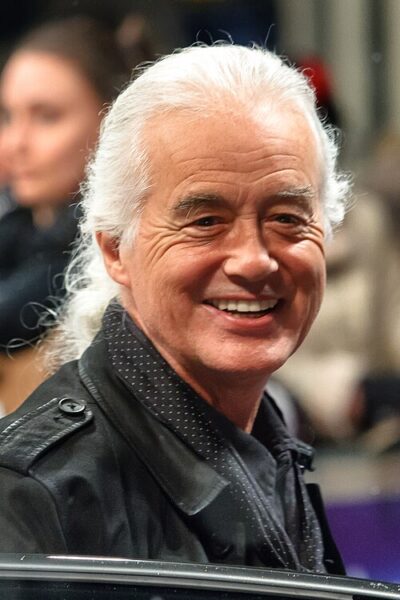
Jimmy Page
Jimmy Page is an English guitarist. Born January 9, 1944, in Heston. Known for Stairway to Heaven, Babe I'm Gonna Leave You and Since I've Been Loving You. Educated at Surrey Institute of Art & Design, University College. Awards include Officer of the Order of the British Empire, Kennedy Center Honors and MOJO Awards.
Facts
43 facts · 1 confirmed by two sources · 15 cited · 27 from one source
Where this comes from
Papalocal keeps its own record. It started from these sources; what each one said is kept here as it was copied, so a change on their side never changes this page by itself. Tap one to read its version.
What Wikidata says · copied November 16, 2026 · revision 2568465209
- Described as
- English guitarist (born 1944)
- Other names
- Jim Page, James Patrick Page
- Born
- January 9, 1944 · 5 references
- Born in
- Heston · 1 reference
- Citizen of
- United Kingdom
- Occupation
- guitarist · 1 reference; composer · 1 reference; songwriter; record producer; musician · 2 references; film actor · 1 reference; film producer · 1 reference; television producer · 1 reference
- Education
- Surrey Institute of Art & Design, University College
- Member of
- The Yardbirds (1966–1968); Led Zeppelin (1968–1980); Page and Plant; London All Star
- Genre
- rock music; hard rock; blues rock; folk rock; progressive rock; blues · 1 reference
- Instrument
- guitar · 1 reference; mandolin; Gibson Les Paul · 1 reference; Gibson EDS-1275 · 1 reference; Fender Stratocaster · 1 reference; Fender Telecaster · 1 reference
- Record label
- Atlantic Records; Swan Song Records
- Known for
- Stairway to Heaven · 1 reference; Babe I'm Gonna Leave You · 1 reference; Since I've Been Loving You · 1 reference; Ramble On · 1 reference; Whole Lotta Love · 1 reference; Rock and Roll · 1 reference
- Awards
- Officer of the Order of the British Empire; Kennedy Center Honors; MOJO Awards
- Spouse
- Patricia Ecker (1986–1995); Jimena Gómez Paratcha (1995–2008)
- Lived in
- Windsor (–2004)
- Website
- https://jimmypage.com/
- Wikipedias with a page
- 78
Wikidata item Q165467 (wikidata.org/wiki/Q165467), public domain (CC0). Copied November 16, 2026.
What Wikipedia says · copied November 16, 2026 · revision 1385774201
James Patrick Page (born 9 January 1944) is an English musician and producer who achieved international success as the guitarist and founder of the rock band Led Zeppelin.
Page began his career as a studio session musician in London and, by the mid-1960s, was a notable session guitarist in Britain. He was a member of the Yardbirds from 1966 to 1968. When the Yardbirds broke up, he founded Led Zeppelin, which was active from 1968 to 1980.
Following the death of Led Zeppelin drummer John Bonham in 1980, Page played with XYZ, the Firm, the Honeydrippers, Coverdale–Page, and Page and Plant. Page performed with many artists, both live and in studio recordings, and in a 2007 Led Zeppelin reunion that was released as the 2012 concert film Celebration Day. Along with the Edge and Jack White, he participated in the 2008 documentary It Might Get Loud.
Page is considered to be one of the greatest and most influential guitarists of all time. Rolling Stone magazine has described Page as "the pontiff of power riffing" and ranked him No. 3 on its 2015 list of the "100 Greatest Guitarists of All Time", behind Jimi Hendrix and Eric Clapton, and No. 3 again in 2023 behind Chuck Berry and Jimi Hendrix. In 2010, Page was ranked No. 2 on Gibson's list of "Top 50 Guitarists of All Time" and, in 2007, No. 4 on Classic Rock's "100 Wildest Guitar Heroes". He was inducted into the Rock and Roll Hall of Fame twice: once as a member of the Yardbirds (1992) and once as a member of Led Zeppelin (1995).
- Born, in its opening lines
- January 9, 1944
From the Wikipedia article “Jimmy Page” (en.wikipedia.org/wiki/Jimmy_Page), by its contributors, under CC BY-SA 4.0 (creativecommons.org/licenses/by-sa/4.0/). Copied November 16, 2026; not changed.
Confirmed Two sources agree. Cited One source, and it names where it got it. One source One source, without a reference of its own. Sources disagree The sources disagree. We show the best-supported value and keep theirs below.
