
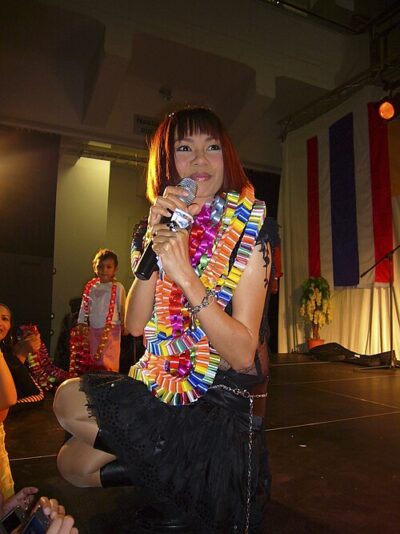
Jintara Poonlarp
Jintara Poonlarp is a Thai female singer. Born March 6, 1969, in Kaset Wisai.
Facts
14 facts · 0 confirmed by two sources · 1 cited · 13 from one source
Where this comes from
Papalocal keeps its own record. It started from these sources; what each one said is kept here as it was copied, so a change on their side never changes this page by itself. Tap one to read its version.
What Wikidata says · copied November 16, 2026 · revision 2553937124
- Described as
- Thai female singer
- Other names
- Thongbai Janlueng, Jin
- Born
- March 6, 1969
- Born in
- Kaset Wisai · 1 reference
- Citizen of
- Thailand
- Occupation
- singer; actor; film actor
- Genre
- mor lam; luk thung; pop music
- Instrument
- voice
- Record label
- GMM Grammy; RS Public Company Limited
- Religion
- Buddhism
- Website
- http://www.jintarafanclub.com/
- Wikipedias with a page
- 78
Wikidata item Q383197 (wikidata.org/wiki/Q383197), public domain (CC0). Copied November 16, 2026.
What Wikipedia says · copied November 16, 2026 · revision 1371681734
Jintara Poonlarp (Thai: จินตหรา พูนลาภ, RTGS: Chintara Phunlap, pronounced [t͡ɕīn.tā.rǎː pʰūːn.lâːp]; b. 6 March 1969, Kaset Wisai district, Roi Et province, Thailand) is a Thai mor lam, luk thung and pop music singer.
She is one of the most popular and prolific of the artists in the mor lam (Thai country) and luk thung (Thai pop-country) genres, having released 50 original albums and 47 singles as well as many compilations. She records roughly equal amounts of mor lam and luk thung, but two of her best-known songs are the string (Thai pop) hits "Ma Tammai" and "Faen Ja," recorded with Thongchai McIntyre.
She is also sometimes known by her nickname Jin or the epithet sao siang pin (Thai: สาวเสียงพิณ, meaning "lute-voiced girl"), and she has a unique identity which is short hair with bangs. She has performed on stage for 33 years.
From the Wikipedia article “Jintara Poonlarp” (en.wikipedia.org/wiki/Jintara_Poonlarp), by its contributors, under CC BY-SA 4.0 (creativecommons.org/licenses/by-sa/4.0/). Copied November 16, 2026; not changed.
Confirmed Two sources agree. Cited One source, and it names where it got it. One source One source, without a reference of its own. Sources disagree The sources disagree. We show the best-supported value and keep theirs below.
