
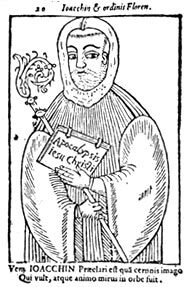
Joachim of Fiore
Joachim of Fiore was an Italian abbot. Born 1135, in Celico. Died March 30, 1202, in Pietrafitta. Positions held include abbot.
Facts
9 facts · 2 confirmed by two sources · 4 cited · 3 from one source
What’s different
- Born: we show 1135 (Confirmed). Wikidata also lists 1130
Where this comes from
Papalocal keeps its own record. It started from these sources; what each one said is kept here as it was copied, so a change on their side never changes this page by itself. Tap one to read its version.
What Wikidata says · copied November 16, 2026 · revision 2547075348
- Described as
- Italian abbot
- Born
- 1135; 1130 · 1 reference
- Died
- March 30, 1202
- Born in
- Celico · 1 reference
- Died in
- Pietrafitta · 1 reference
- Buried in
- San Giovanni in Fiore Abbey
- Occupation
- theologian · 1 reference; founder of Catholic religious community · 1 reference
- Positions held
- abbot
- Religion
- Christianity
- Wikipedias with a page
- 35
Wikidata item Q199991 (wikidata.org/wiki/Q199991), public domain (CC0). Copied November 16, 2026.
What Wikipedia says · copied November 16, 2026 · revision 1385560730
Joachim of Fiore, also known as Joachim of Flora (Italian: Gioacchino da Fiore; Latin: Ioachim Florensis; c. 1135 – 30 March 1202), was an Italian Christian theologian, Catholic abbot, and the founder of the monastic order of San Giovanni in Fiore. According to theologian Bernard McGinn, "Joachim of Fiore is the most important apocalyptic thinker of the whole medieval period." The Divine Comedy of Dante Alighieri is one of the most famous works possibly inspired by his ideas. Later followers, inspired by his works in Christian eschatology and historicist theories, are called Joachimites.
- Born, in its opening lines
- c. 1135
- Died, in its opening lines
- March 30, 1202
From the Wikipedia article “Joachim of Fiore” (en.wikipedia.org/wiki/Joachim_of_Fiore), by its contributors, under CC BY-SA 4.0 (creativecommons.org/licenses/by-sa/4.0/). Copied November 16, 2026; not changed.
Confirmed Two sources agree. Cited One source, and it names where it got it. One source One source, without a reference of its own. Sources disagree The sources disagree. We show the best-supported value and keep theirs below.
