
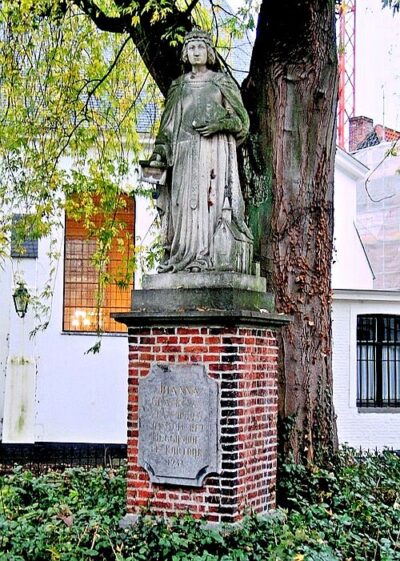
Joan, Countess of Flanders
Joan, Countess of Flanders was a Countess of Flanders. Born 1200, in Valenciennes. Died December 5, 1244, in Marquette-lez-Lille. Positions held include Count of Flanders (1205–1244) and count of Hainaut (1205–1244).
Facts
13 facts · 1 confirmed by two sources · 3 cited · 8 from one source · 1 where the sources disagree
What’s different
- Born: we show 1200 (Sources disagree). Wikipedia says c. 1199
Where this comes from
Papalocal keeps its own record. It started from these sources; what each one said is kept here as it was copied, so a change on their side never changes this page by itself. Tap one to read its version.
What Wikidata says · copied November 17, 2026 · revision 2567301903
- Described as
- Countess of Flanders (1200-1244)
- Other names
- Jeanne de Constantinople, Johanna of Flanders
- Born
- 1200 · 1 reference
- Died
- December 5, 1244 · 1 reference
- Born in
- Valenciennes
- Died in
- Marquette-lez-Lille · 1 reference
- Buried in
- Marquette-lez-Lille · 1 reference
- Occupation
- politician
- Positions held
- Count of Flanders (1205–1244); count of Hainaut (1205–1244)
- Spouse
- Ferdinand of Portugal (1212–) · 1 reference; Thomas II, Regent of Savoy
- Father
- Baldwin I of Constantinople · 1 reference
- Mother
- Marie of Champagne
- Siblings
- Margaret II, Countess of Flanders · 1 reference
- Wikipedias with a page
- 26
Wikidata item Q466311 (wikidata.org/wiki/Q466311), public domain (CC0). Copied November 17, 2026.
What Wikipedia says · copied November 17, 2026 · revision 1376638156
Joan, often called Joan of Constantinople (c. 1199 – 5 December 1244), was the countess of Flanders and Hainaut from 1205 (at the age of six) until her death. She was the elder daughter of Baldwin IX, Count of Flanders and Hainaut, and Marie of Champagne.
Orphaned during the Fourth Crusade, Joan was raised in Paris under the tutelage of King Philip II of France. He arranged her marriage to Infante Ferdinand of Portugal in 1212. Ferdinand quickly turned against Philip, starting a war that ended with the defeat of Bouvines and his imprisonment. Joan then ruled her counties alone from the age of 14. She faced the rivalry of her younger sister, Margaret, as well as the revolt of her domains – guided by a man who claimed to be her father. After the end of the war, Ferdinand was released but died soon after. Joan then married Thomas of Savoy. She died in 1244 at the Abbey of Marquette near Lille, having survived her only child, a daughter by Ferdinand.
Joan's policies favored economic development in her counties; in fact, she granted several charters to the Flemish cities. She played an important role in the development of the Mendicant orders, the Beguines, the Victorines and hospital communities in her domains (without neglecting the traditional religious orders). Under her reign, women's foundations increased, transforming the place of women in both society and the church.
The Manessier's Continuation (also called the Third Continuation), one of the novels of the Story of the Grail was written for Joan, as well as the Life of St. Martha of Wauchier de Denain. The first novel in Dutch, Van den vos Reynaerde, was written by a cleric of her court.
There are several painted or sculpted representations of the Countess in France and Belgium, as well as two Géants du Nord.
- Born, in its opening lines
- c. 1199
- Died, in its opening lines
- December 5, 1244
From the Wikipedia article “Joan, Countess of Flanders” (en.wikipedia.org/wiki/Joan,_Countess_of_Flanders), by its contributors, under CC BY-SA 4.0 (creativecommons.org/licenses/by-sa/4.0/). Copied November 17, 2026; not changed.
Confirmed Two sources agree. Cited One source, and it names where it got it. One source One source, without a reference of its own. Sources disagree The sources disagree. We show the best-supported value and keep theirs below.
