
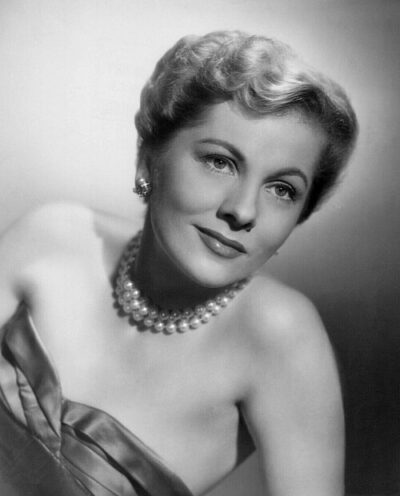
Joan Fontaine
Joan Fontaine was a British actress. Born October 22, 1917, in Tokyo. Died December 15, 2013, in Carmel-by-the-Sea. Educated at American School in Japan and Los Gatos High School. Awards include Academy Award for Best Actress and star on Hollywood Walk of Fame.
Facts
24 facts · 2 confirmed by two sources · 10 cited · 12 from one source
Where this comes from
Papalocal keeps its own record. It started from these sources; what each one said is kept here as it was copied, so a change on their side never changes this page by itself. Tap one to read its version.
What Wikidata says · copied November 13, 2026 · revision 2568864042
- Described as
- British actress (1917–2013)
- Other names
- Joan de Beauvoir de Havilland
- Born
- October 22, 1917 · 16 references
- Died
- December 15, 2013 · 15 references
- Born in
- Tokyo · 1 reference
- Died in
- Carmel-by-the-Sea · 1 reference
- Citizen of
- United Kingdom; United States (1943–)
- Occupation
- actor · 1 reference; writer; television actor · 1 reference; interior designer · 1 reference
- Worked for
- Warner Bros. Entertainment
- Education
- American School in Japan; Los Gatos High School · 1 reference; International School of the Sacred Heart
- Awards
- Academy Award for Best Actress (1942) · 1 reference; star on Hollywood Walk of Fame · 1 reference
- Spouse
- Brian Aherne (1939–1945) · 1 reference; Collier Young (1952–1961) · 2 references; William Dozier (1946–1951) · 2 references; Alfred Wright, Jr. (1964–1969) · 1 reference
- Children
- Deborah Dozier Potter · 2 references
- Father
- Walter Augustus de Havilland
- Mother
- Lilian Fontaine · 1 reference
- Siblings
- Olivia de Havilland · 1 reference
- Wikipedias with a page
- 77
Wikidata item Q95076 (wikidata.org/wiki/Q95076), public domain (CC0). Copied November 13, 2026.
What Wikipedia says · copied November 13, 2026 · revision 1379445585
Joan de Beauvoir de Havilland (October 22, 1917 – December 15, 2013), known professionally as Joan Fontaine, was a British-American actress best known for her film roles during the Golden Age of Hollywood. Fontaine appeared in more than 45 films in a career that spanned five decades. She was the younger sister of actress Olivia de Havilland. Their rivalry was well documented in the media at the height of Fontaine's career.
Fontaine began her film career in 1935, signing a contract with RKO Pictures. Fontaine received her first major roles in The Man Who Found Himself (1937) and in Gunga Din (1939). Her career prospects improved greatly after her starring role in Alfred Hitchcock's Rebecca (1940), for which she received her first of three nominations for the Academy Award for Best Actress. The following year, she won that award for her role in Hitchcock's Suspicion (1941). A third nomination came with The Constant Nymph (1943). She appeared mostly in drama films through the 1940s, including Letter from an Unknown Woman and the comedy You Gotta Stay Happy (both 1948), which she co-produced with her second husband William Dozier through their film production company Rampart Productions. In the next decade, after her role in Ivanhoe (1952), her film career began to decline and she moved into stage, radio and television roles. She appeared in fewer films in the 1960s, which included Voyage to the Bottom of the Sea (1961), and her final film role in The Witches (1966), also known as The Devil's Own.
She released an autobiography, No Bed of Roses, in 1978, and continued to act until 1994. Her Academy Award for Suspicion makes Fontaine the only actress to have won an Oscar for acting in a Hitchcock film. She and her sister Olivia remain the only siblings to have won lead-acting Academy Awards.
- Born, in its opening lines
- October 22, 1917
- Died, in its opening lines
- December 15, 2013
From the Wikipedia article “Joan Fontaine” (en.wikipedia.org/wiki/Joan_Fontaine), by its contributors, under CC BY-SA 4.0 (creativecommons.org/licenses/by-sa/4.0/). Copied November 13, 2026; not changed.
Confirmed Two sources agree. Cited One source, and it names where it got it. One source One source, without a reference of its own. Sources disagree The sources disagree. We show the best-supported value and keep theirs below.
