
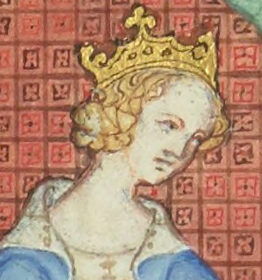
Joan II of Navarre
Joan II of Navarre was a Queen of Navarre. Born January 28, 1311, in Conflans-Sainte-Honorine. Died October 6, 1349, in Charenton-le-Pont. Positions held include Sovereign of Navarre (1328–1349).
Facts
22 facts · 1 confirmed by two sources · 6 cited · 14 from one source · 1 where the sources disagree
What’s different
- Born: we show January 28, 1311 (Sources disagree). Wikipedia says January 28, 1312
Where this comes from
Papalocal keeps its own record. It started from these sources; what each one said is kept here as it was copied, so a change on their side never changes this page by itself. Tap one to read its version.
What Wikidata says · copied November 16, 2026 · revision 2558484375
- Described as
- Queen of Navarre (1328-1349)
- Other names
- Joan of Navarre
- Born
- January 28, 1311
- Died
- October 6, 1349
- Born in
- Conflans-Sainte-Honorine
- Died in
- Charenton-le-Pont · 1 reference
- Buried in
- Basilica of Saint-Denis
- Cause of death
- plague
- Citizen of
- Kingdom of France; Kingdom of Navarre
- Occupation
- politician
- Positions held
- Sovereign of Navarre (1328–1349)
- Spouse
- Philip III of Navarre (1329–) · 2 references
- Children
- Maria of Navarre · 1 reference; Blanche of Navarre, Queen of France · 1 reference; Charles II of Navarre · 1 reference; Philip, Count of Longueville; Louis, Duke of Durazzo; Jeanne de Navarre; Agnès de Navarre; Jeanne de Navarre · 1 reference
- Father
- Louis X of France · 1 reference
- Mother
- Margaret of Burgundy · 1 reference
- Siblings
- John I of France
- Wikipedias with a page
- 42
Wikidata item Q230031 (wikidata.org/wiki/Q230031), public domain (CC0). Copied November 16, 2026.
What Wikipedia says · copied November 16, 2026 · revision 1359659483
Joan II (French: Jeanne, Spanish: Juana II, Basque: Joana II; 28 January 1312 – 6 October 1349) was Queen of Navarre from 1328 until her death in 1349.
Joan was the only surviving child of Louis I of Navarre and Margaret of Burgundy. Her father ascended the French throne as Louis X in 1314. Joan's paternity was dubious because her mother was involved in a scandal, but Louis declared her his legitimate daughter before he died in 1316. However, due to Salic Law, females were excluded from the line of succession, and Louis's brother was declared king as Philip V. The Navarrese noblemen also paid homage to Philip. Joan's maternal grandmother, Agnes of France, and uncle, Odo IV of Burgundy, made attempts to secure the counties of Champagne and Brie (which had been the patrimony of Joan's paternal grandmother, Joan I of Navarre) to Joan, but the French royal troops defeated her supporters. After Philip V married his daughter to Odo and granted him two counties as her dowry, Odo renounced Joan's claim to Champagne and Brie in exchange for a compensation in March 1318. At this time, Joan married her cousin Philip of Évreux (later Philip III of Navarre).
In 1322, Philip V was succeeded by his brother Charles IV in both France and Navarre, but most Navarrese lords refused to swear loyalty to him. After Charles IV died in 1328, the Navarrese expelled the French governor and declared Joan the rightful monarch of Navarre. In France, Philip of Valois was crowned king as Philip VI. He concluded an agreement with Joan and her husband, who renounced Joan's claims to Champagne and Brie in exchange for three counties, while Philip acknowledged their right to Navarre. Joan II and Philip III were crowned in Pamplona Cathedral in March 1329. The royal couple closely cooperated during their joint reign, but Philip III was more active. However, they mostly lived in their French domains, with Navarre being administered by governors during their absences. Philip died in 1343. Joan succumbed to the Black Death in 1349, and was succeeded by her son Charles II.
- Born, in its opening lines
- January 28, 1312
- Died, in its opening lines
- October 6, 1349
From the Wikipedia article “Joan II of Navarre” (en.wikipedia.org/wiki/Joan_II_of_Navarre), by its contributors, under CC BY-SA 4.0 (creativecommons.org/licenses/by-sa/4.0/). Copied November 16, 2026; not changed.
Confirmed Two sources agree. Cited One source, and it names where it got it. One source One source, without a reference of its own. Sources disagree The sources disagree. We show the best-supported value and keep theirs below.
