
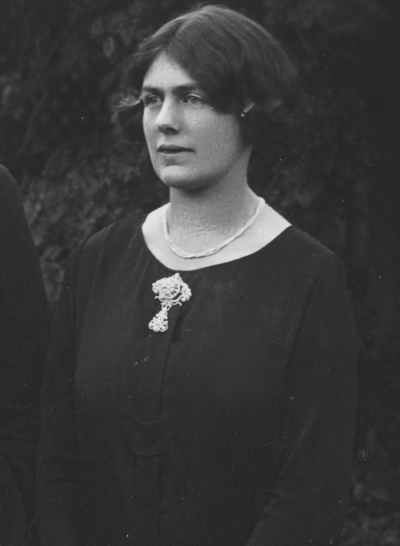
Joan Lindsay
Joan Lindsay was an Australian writer. Born November 16, 1896, in St Kilda. Died December 23, 1984, in Frankston. Educated at National Gallery of Victoria Art School.
Facts
22 facts · 2 confirmed by two sources · 13 cited · 7 from one source
Where this comes from
Papalocal keeps its own record. It started from these sources; what each one said is kept here as it was copied, so a change on their side never changes this page by itself. Tap one to read its version.
What Wikidata says · copied November 18, 2026 · revision 2567244850
- Described as
- Australian writer (1896-1984)
- Born
- November 16, 1896 · 3 references
- Died
- December 23, 1984 · 3 references
- Born in
- St Kilda · 1 reference
- Died in
- Frankston · 1 reference
- Cause of death
- stomach cancer
- Citizen of
- Australia
- Occupation
- writer · 1 reference; poet · 1 reference; novelist · 1 reference; painter · 1 reference; playwright · 1 reference; essayist · 1 reference; artist · 1 reference; satirical novelist
- Education
- National Gallery of Victoria Art School · 1 reference
- Field
- literature · 1 reference; drama · 1 reference; essay · 1 reference; visual arts · 1 reference; poetry · 1 reference
- Spouse
- Daryl Lindsay
- Lived in
- Mulberry Hill · 1 reference
- Wikipedias with a page
- 20
Wikidata item Q453983 (wikidata.org/wiki/Q453983), public domain (CC0). Copied November 18, 2026.
What Wikipedia says · copied November 18, 2026 · revision 1385923774
Joan à Beckett Weigall, Lady Lindsay (16 November 1896 – 23 December 1984) was an Australian novelist, playwright, essayist, and visual artist. Trained in her youth as a painter, she published her first literary work in 1936 at age forty under a pseudonym, a satirical novel titled Through Darkest Pondelayo. Her second novel, Time Without Clocks, was published nearly thirty years later, and was a semi-autobiographical account of the early years of her marriage to artist Sir Daryl Lindsay.
In 1967, Lindsay published her most celebrated work, Picnic at Hanging Rock, a historical Gothic novel detailing the vanishing of three schoolgirls and their teacher at the site of a monolith during one summer. The novel sparked critical and public interest for its ambivalent presentation as a true story as well as its vague conclusion, and is widely considered to be one of the most important Australian novels. It was adapted into a 1975 film of the same name.
She was also the author of several unpublished plays, and contributed essays, short stories, and poetry to numerous journals and publications throughout her career. After the death of Lindsay's husband in 1976, she spent her time involved in the local art community in Melbourne, and was involved in several exhibitions. Her last published work, Syd Sixpence (1982), was her first and only work of children's literature. Lindsay died of stomach cancer in 1984, after which her home was donated to the Australian National Trust; the Lindsay estate now operates as a museum with her and her husband Daryl's artwork and personal effects.
- Born, in its opening lines
- November 16, 1896
- Died, in its opening lines
- December 23, 1984
From the Wikipedia article “Joan Lindsay” (en.wikipedia.org/wiki/Joan_Lindsay), by its contributors, under CC BY-SA 4.0 (creativecommons.org/licenses/by-sa/4.0/). Copied November 18, 2026; not changed.
Confirmed Two sources agree. Cited One source, and it names where it got it. One source One source, without a reference of its own. Sources disagree The sources disagree. We show the best-supported value and keep theirs below.
