
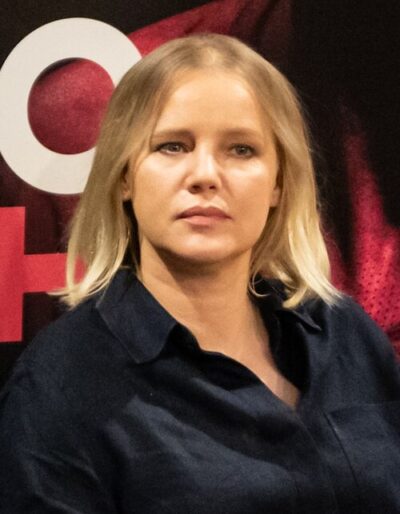
Joanna Kulig
Joanna Kulig is a Polish actress and singer. Born June 24, 1982, in Krynica-Zdrój. Educated at AST National Academy of Theatre Arts in Kraków. Awards include European Film Award for Best Actress.
Facts
12 facts · 1 confirmed by two sources · 2 cited · 9 from one source
Where this comes from
Papalocal keeps its own record. It started from these sources; what each one said is kept here as it was copied, so a change on their side never changes this page by itself. Tap one to read its version.
What Wikidata says · copied November 16, 2026 · revision 2545452319
- Described as
- Polish actress and singer
- Born
- June 24, 1982 · 2 references
- Born in
- Krynica-Zdrój
- Citizen of
- Poland
- Occupation
- actor · 1 reference; stage actor; singer · 1 reference; film actor · 1 reference
- Education
- AST National Academy of Theatre Arts in Kraków
- Instrument
- voice
- Awards
- European Film Award for Best Actress (2018) · 1 reference
- Spouse
- Maciek Bochniak
- Siblings
- Justyna Schneider
- Wikipedias with a page
- 31
Wikidata item Q3179653 (wikidata.org/wiki/Q3179653), public domain (CC0). Copied November 16, 2026.
What Wikipedia says · copied November 16, 2026 · revision 1385846104
Joanna Kulig (Polish: [jɔˈanna ˈkulik]; born 24 June 1982) is a Polish actress and singer. Noted for performing in different languages, she has worked in film, television and radio as well as on stage. She is the recipient of a European Film Award and two Polish Film Awards, and her work has been recognised at various film festivals. In 2018, Polish magazine Wprost included her among the 50 most influential Poles for her contributions to the cinema of Poland.
After an unsuccessful attempt at a career as a jazz singer, Kulig enrolled at the AST National Academy of Theatre Arts in Kraków, graduating in 2007. She began performing on stage while still in drama school, debuting in the play A Midsummer Night's Dream. Her first starring film role in the 2007 drama Wednesday, Thursday Morning won her the award for Best Debut at the Polish Film Festival. She received further acclaim for her performance in the 2011 film Elles, which earned her Best Supporting Actress at the Polish Film Awards and Polish Film Festival.
Kulig became a frequent collaborator with director Paweł Pawlikowski. She appeared in four of his films: The Woman in the Fifth (2011), Ida (2013), Cold War (2018) and Fatherland (2026). Her starring role in Cold War earned her widespread recognition and Best Actress accolades at the European Film Awards and Polish Film Awards.
Kulig also received Polish Film Award nominations for her roles in the films Lasting (2013) and Woman Of... (2023). She achieved commercial success with Pitbull: Tough Women (2016) and Clergy (2018), both of which rank among the highest-grossing Polish films of all time. Her other film credits include Disco Polo (2015), The Innocents (2016), Kompromat (2022), She Came to Me (2023), Knox Goes Away (2023) and Wild, Wild East (2026). On television, she played the lead role in the sitcom Don't Worry About Me (2014–2018) and starred in the Netflix series The Eddy (2020) and Lead Children (2026).
- Born, in its opening lines
- June 24, 1982
From the Wikipedia article “Joanna Kulig” (en.wikipedia.org/wiki/Joanna_Kulig), by its contributors, under CC BY-SA 4.0 (creativecommons.org/licenses/by-sa/4.0/). Copied November 16, 2026; not changed.
Confirmed Two sources agree. Cited One source, and it names where it got it. One source One source, without a reference of its own. Sources disagree The sources disagree. We show the best-supported value and keep theirs below.
