
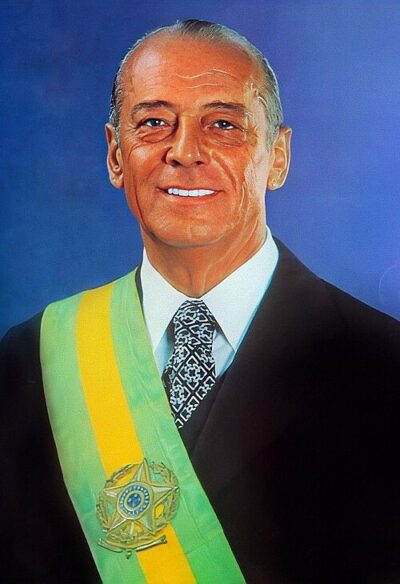
João Figueiredo
João Figueiredo was a Brazilian politician and military officer, 30th President of Brazil from 1979 to 1985. Born January 15, 1918, in Rio de Janeiro. Died December 24, 1999, in Rio de Janeiro. Positions held include President of Brazil (1979–1985) and president. Educated at Academia Militar das Agulhas Negras. Awards include Collar of the Order of Isabella the Catholic, Grand Cross of the Order of the Southern Cross and Order of Rio Branco.
Facts
29 facts · 2 confirmed by two sources · 10 cited · 17 from one source
Where this comes from
Papalocal keeps its own record. It started from these sources; what each one said is kept here as it was copied, so a change on their side never changes this page by itself. Tap one to read its version.
What Wikidata says · copied November 16, 2026 · revision 2559447193
- Described as
- Brazilian politician and military officer, 30th President of Brazil from 1979 to 1985
- Other names
- João Baptista Figueiredo
- Born
- January 15, 1918 · 3 references
- Died
- December 24, 1999 · 3 references
- Born in
- Rio de Janeiro · 2 references
- Died in
- Rio de Janeiro · 1 reference
- Buried in
- Caju Cemetery · 1 reference
- Cause of death
- cardiovascular disease
- Citizen of
- Brazil
- Occupation
- politician; military officer; military personnel · 1 reference
- Positions held
- President of Brazil (1979–1985) · 1 reference; president · 1 reference
- Political party
- National Renewal Alliance Party
- Education
- Academia Militar das Agulhas Negras
- Awards
- Collar of the Order of Isabella the Catholic (1983) · 1 reference; Grand Cross of the Order of the Southern Cross; Order of Rio Branco; Order of Naval Merit; Grand Cross of the Military Order of Avis · 1 reference; Grand Cross of the Order of Prince Henry · 1 reference; Knight of the Seraphim; Collar of the Spanish Order of the Civil Merit (1979) · 1 reference; Grand Cross of the Military Order of Christ · 1 reference; Grand Collar of the Military Order of Saint James of the Sword · 1 reference
- Spouse
- Dulce Figueiredo (–1999)
- Father
- Euclides Figueiredo
- Military branch
- Brazilian Army · 1 reference
- Military rank
- general · 1 reference; general of the army
- Wikipedias with a page
- 48
Wikidata item Q192377 (wikidata.org/wiki/Q192377), public domain (CC0). Copied November 16, 2026.
What Wikipedia says · copied November 16, 2026 · revision 1383121661
João Baptista de Oliveira Figueiredo (Portuguese: [ʒuˈɐ̃w baˈtʃistɐ dʒi oliˈvejɾɐ fiɡejˈɾedu, ˈʒwɐ̃w -]; 15 January 1918 – 24 December 1999) was a Brazilian military officer who served as the 30th president of Brazil from 1979 to 1985, and the last of the military regime that ruled the country following the 1964 Brazilian coup d'état. He was chief of the Secret Service (SNI) during the term of his predecessor, Ernesto Geisel, who appointed him to the presidency at the end of his own term.
Amendments to the Constitution increased the presidential term length from five to six years, while Figueiredo's presidency continued the political liberalization started under Geisel. Shortly after taking office, he approved a broad amnesty for politicians who had been removed from office under the Institutional Acts. In 1980, the two-party system was abolished, leading to the creation of the Brazilian Democratic Movement Party (PMDB) as the successor to the MDB and the Democratic Social Party (PDS) as the successor to ARENA, along with several new parties. Figueiredo joined the PDS. On September 22, 1981, he was awarded Portugal's Grand Collar of the Military Order of Saint James of the Sword. In 1982, electoral reforms were introduced to secure a majority for the ruling PDS in the upcoming elections against four opposition parties. However, his presidency saw several terrorist attacks attributed to hardline right-wing and military factions.
Figueiredo's term was marked by a severe global economic crisis, rising international interest rates, the second oil shock of 1979, and skyrocketing inflation, which surged from 45% to 230% over six years. Brazil's foreign debt exceeded $100 billion for the first time, forcing the government to seek assistance from the International Monetary Fund (IMF) in 1982. That same year, the state of Rondônia was created. In 1983, the Diretas Já movement pushed for direct presidential elections, but the proposal was rejected by Congress. However, the Figueiredo administration allowed an indirect presidential election, ultimately leading to the end of Brazil's military regime.
According to CIA documents, João Figueiredo supported the continuation of summary executions of political dissidents, in violation of legal and constitutional norms, as well as human rights principles.
- Born, in its opening lines
- January 15, 1918
- Died, in its opening lines
- December 24, 1999
From the Wikipedia article “João Figueiredo” (en.wikipedia.org/wiki/João_Figueiredo), by its contributors, under CC BY-SA 4.0 (creativecommons.org/licenses/by-sa/4.0/). Copied November 16, 2026; not changed.
Confirmed Two sources agree. Cited One source, and it names where it got it. One source One source, without a reference of its own. Sources disagree The sources disagree. We show the best-supported value and keep theirs below.
