
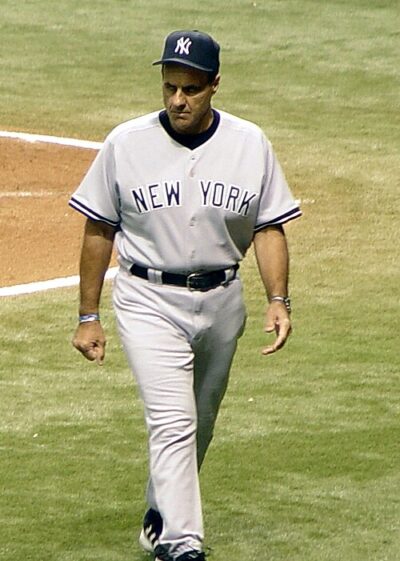
Joe Torre is an American baseball player, coach, manager. Born July 18, 1940, in Brooklyn. Teams include New York Mets, Atlanta Braves and St. Louis Cardinals. Educated at St. Francis Preparatory School. Awards include Rawlings Gold Glove Award, Major League Baseball Most Valuable Player Award and National Baseball Hall of Fame and Museum.
Facts
14 facts · 1 confirmed by two sources · 3 cited · 10 from one source
Where this comes from
Papalocal keeps its own record. It started from these sources; what each one said is kept here as it was copied, so a change on their side never changes this page by itself. Tap one to read its version.
What Wikidata says · copied November 18, 2026 · revision 2529675420
- Described as
- American baseball player, coach, manager
- Other names
- Joseph Paul Torre
- Born
- July 18, 1940
- Born in
- Brooklyn
- Citizen of
- United States
- Occupation
- baseball player · 1 reference
- Education
- St. Francis Preparatory School
- Teams
- New York Mets; Atlanta Braves; St. Louis Cardinals
- Sport
- baseball · 1 reference
- Awards
- Rawlings Gold Glove Award (1965); Major League Baseball Most Valuable Player Award (1971) · 1 reference; National Baseball Hall of Fame and Museum (2014)
- Siblings
- Frank Torre
- Height
- 1.88 m (6 ft 2 in) · 1 reference
- Wikipedias with a page
- 19
Wikidata item Q707804 (wikidata.org/wiki/Q707804), public domain (CC0). Copied November 18, 2026.
What Wikipedia says · copied November 18, 2026 · revision 1382538564
Joseph Paul Torre Jr. (; born July 18, 1940) is an American professional baseball executive and former player, manager, and television color commentator. He has served as a special assistant to the commissioner of Major League Baseball since 2020. He previously served in the capacity of Major League Baseball's (MLB) chief baseball officer from 2011 to 2020. Torre ranks fifth all-time in MLB history with 2,326 wins as a manager. With 2,342 hits during his playing career, Torre is the only major leaguer to achieve both 2,000 hits as a player and 2,000 wins as a manager. From 1996 to 2007, he was the manager of the New York Yankees, and guided the team to six American League (AL) pennants and four World Series championships.
Torre's professional baseball career began as a player in 1960 with the Milwaukee Braves, as a catcher and first baseman. He also played for the St. Louis Cardinals (for whom he played primarily third base) and the New York Mets, until becoming a manager in 1977, when he briefly served as the Mets' player-manager before retiring as a player. His managerial career covered 29 seasons, including tenures with the same three clubs for which he had played, and also stints with the Yankees and the Los Angeles Dodgers, until 2010. From 1984 to 1989, he served as a television color commentator for the California Angels and for NBC. After retiring as a manager, he accepted a role assisting the Commissioner as the executive vice president of baseball operations.
A nine-time All-Star, Torre won the 1971 National League (NL) Most Valuable Player (MVP) Award after leading the major leagues in batting average, hits, and runs batted in. After qualifying for the playoffs just once while managing the Mets, Braves, and Cardinals (leading the Braves to the 1982 NL West title, before losing in the NLCS), Torre's greatest success came as manager of the Yankees. His Yankee clubs compiled a .605 regular-season winning percentage and made the playoffs every year, winning four World Series titles, six AL pennants, and ten AL East division titles. In 1996 and 1998, he was the AL Manager of the Year. He also won two NL West division titles with the Dodgers, for a total of 13 division titles. In 2014, Torre was elected to the National Baseball Hall of Fame.
- Born, in its opening lines
- July 18, 1940
From the Wikipedia article “Joe Torre” (en.wikipedia.org/wiki/Joe_Torre), by its contributors, under CC BY-SA 4.0 (creativecommons.org/licenses/by-sa/4.0/). Copied November 18, 2026; not changed.
Confirmed Two sources agree. Cited One source, and it names where it got it. One source One source, without a reference of its own. Sources disagree The sources disagree. We show the best-supported value and keep theirs below.
