
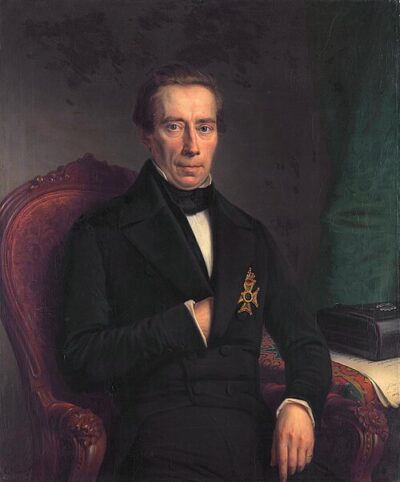
Johan Rudolph Thorbecke
Johan Rudolph Thorbecke was a Dutch statesman. Born January 14, 1798, in Zwolle. Died June 4, 1872, in The Hague. Positions held include Prime Minister of the Netherlands (3 times) (1849–1872), member of the House of Representatives of the Netherlands (4 times) (1844–1871) and Minister of the Interior and Kingdom Relations. Educated at Leiden University. Awards include Commander of the Order of the Netherlands Lion and Knight Grand Cross in the Order of the Netherlands Lion.
Facts
32 facts · 2 confirmed by two sources · 10 cited · 20 from one source
What’s different
- Died: we show June 4, 1872 (Confirmed). Wikidata also lists June 5, 1872
Where this comes from
Papalocal keeps its own record. It started from these sources; what each one said is kept here as it was copied, so a change on their side never changes this page by itself. Tap one to read its version.
What Wikidata says · copied November 16, 2026 · revision 2568183307
- Described as
- Dutch statesman (1798-1872)
- Other names
- Johan Rudolf Thorbecke, J.R. Thorbecke
- Born
- January 14, 1798 · 9 references
- Died
- June 4, 1872 · 4 references; June 5, 1872 · 1 reference
- Born in
- Zwolle
- Died in
- The Hague
- Buried in
- The Hague General Cemetery
- Cause of death
- pneumonia
- Citizen of
- Kingdom of the Netherlands; Batavian Republic; Sovereign Principality of the United Netherlands
- Occupation
- jurist · 1 reference; politician · 2 references; historian; university teacher · 2 references; political scientist · 1 reference
- Positions held
- Prime Minister of the Netherlands (3 times) (1849–1872); member of the House of Representatives of the Netherlands (4 times) (1844–1871) · 1 reference; Minister of the Interior and Kingdom Relations; rector magnificus of Leiden University; full professor · 1 reference
- Political party
- liberals
- Worked for
- Ghent University; Leiden University (1831–) · 1 reference
- Education
- Leiden University
- Member of
- Royal Netherlands Academy of Arts and Sciences · 1 reference
- Awards
- Commander of the Order of the Netherlands Lion (1851) · 1 reference; Knight Grand Cross in the Order of the Netherlands Lion (1863) · 1 reference
- Field
- international relations
- Spouse
- Adelheid Ernestine Caroline Henriëtte Solger (1836–1870) · 1 reference
- Children
- Henriette Thorbecke; Marie Thorbecke; Willem Thorbecke
- Religion
- Lutheranism
- Wikipedias with a page
- 42
Wikidata item Q182509 (wikidata.org/wiki/Q182509), public domain (CC0). Copied November 16, 2026.
What Wikipedia says · copied November 16, 2026 · revision 1378385530
Johan Rudolph Thorbecke (14 January 1798 – 4 June 1872) was a Dutch liberal statesman. As the leading figure in the Constitutional Reform of 1848, he is considered the founder of parliamentary democracy in the Netherlands, and the most important Dutch statesman of the 19th century.
Born in Zwolle in 1798 to a financially struggling Lutheran merchant family of German origin, Thorbecke attended a Latin school and studied law and humanities in Amsterdam and Leiden. After receiving his doctorate in 1820, he spent four years in Germany, where met contemporary philosophers and was introduced to the ideas of Romanticism and historism. After his return to the Netherlands, he became a professor, first at Ghent University and, after the Belgian Revolution, at Leiden University. In Leiden, Thorbecke's writings became increasingly political in nature, and he soon became a leading figure in the charge for constitutional reform. He was elected to the House of Representatives in 1844, and made an unsuccessful attempt at constitutional reform as part of a group called the Negenmannen.
Amid the Revolutions of 1848, King William II appointed a constitutional reform commission headed by Thorbecke. In this capacity, he virtually single-handedly wrote a new Constitution of the Netherlands, which was adopted on 3 November of that year in slightly amended form. Among the changes introduced by the new Constitution were ministerial responsibility and direct elections to the House of Representatives, thus turning the Netherlands into a constitutional monarchy with a parliamentary system. During his first ministry (1849–1853), Thorbecke built upon the Constitution with several organic laws, including the Municipalities Act, which introduced local self-government. During his second ministry (1862–1866), he introduced the Hogere Burgerschool, which expanded secondary education to the middle class.
Thorbecke died in 1872, a year into his third ministry. His 1848 Constitution and his subsequent reforms had a lasting impact on Dutch politics and society. He has been commemorated with three statues, in Zwolle, The Hague and Amsterdam, the latter of which is in the centre of the Thorbeckeplein (Thorbecke Square).
- Born, in its opening lines
- January 14, 1798
- Died, in its opening lines
- June 4, 1872
From the Wikipedia article “Johan Rudolph Thorbecke” (en.wikipedia.org/wiki/Johan_Rudolph_Thorbecke), by its contributors, under CC BY-SA 4.0 (creativecommons.org/licenses/by-sa/4.0/). Copied November 16, 2026; not changed.
Confirmed Two sources agree. Cited One source, and it names where it got it. One source One source, without a reference of its own. Sources disagree The sources disagree. We show the best-supported value and keep theirs below.
