
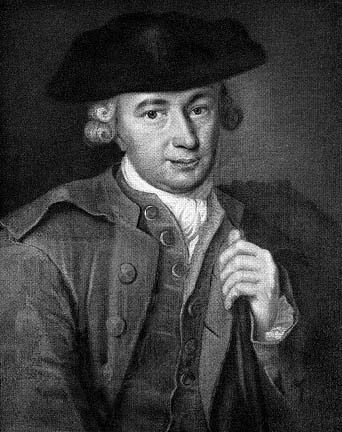
Johann Georg Hamann
Johann Georg Hamann was a German philosopher. Born August 27, 1730, in Königsberg. Died June 21, 1788, in Münster.
Facts
16 facts · 2 confirmed by two sources · 5 cited · 9 from one source
Where this comes from
Papalocal keeps its own record. It started from these sources; what each one said is kept here as it was copied, so a change on their side never changes this page by itself. Tap one to read its version.
What Wikidata says · copied November 16, 2026 · revision 2568901200
- Described as
- German philosopher (1730-1788)
- Other names
- Johann G. Hamann
- Born
- August 27, 1730 · 13 references
- Died
- June 21, 1788 · 12 references
- Born in
- Königsberg · 2 references
- Died in
- Münster · 3 references
- Buried in
- Überwasserfriedhof Münster
- Citizen of
- Kingdom of Prussia
- Occupation
- philosopher · 1 reference; writer · 1 reference; lutenist; theologian · 1 reference; art historian · 2 references
- Instrument
- lute
- Children
- Johann Michael Hamann; Magdalena Katharina Rosenberger; Marianna Sophie Nicolovius
- Religion
- Lutheranism
- Wikipedias with a page
- 45
Wikidata item Q76499 (wikidata.org/wiki/Q76499), public domain (CC0). Copied November 16, 2026.
What Wikipedia says · copied November 16, 2026 · revision 1379803909
Johann Georg Hamann (; German: [ˈhaːman]; 27 August 1730 – 21 June 1788) was a German Lutheran philosopher from Königsberg. Known by the pen name "the Magus (Wizard) of the North", he was one of the leading figures of post-Kantian philosophy. His work was used by his student Johann Gottfried Herder as the main support of the Sturm und Drang movement, and is associated with the Counter-Enlightenment and Romanticism.
He introduced Kant, also from Königsberg, to the works of both David Hume – which Kant credited with waking him from his "dogmatic slumber" – and Jean-Jacques Rousseau. Hamann was influenced by Hume, but he used his views to argue for rather than against Christianity.
Johann Wolfgang von Goethe and Søren Kierkegaard were among those who considered him to be the finest mind of his time. He was also a key influence on G. W. F. Hegel and Friedrich Jacobi. Long before the linguistic turn, Hamann believed epistemology should be replaced by the philosophy of language.
- Born, in its opening lines
- August 27, 1730
- Died, in its opening lines
- June 21, 1788
From the Wikipedia article “Johann Georg Hamann” (en.wikipedia.org/wiki/Johann_Georg_Hamann), by its contributors, under CC BY-SA 4.0 (creativecommons.org/licenses/by-sa/4.0/). Copied November 16, 2026; not changed.
Confirmed Two sources agree. Cited One source, and it names where it got it. One source One source, without a reference of its own. Sources disagree The sources disagree. We show the best-supported value and keep theirs below.
