
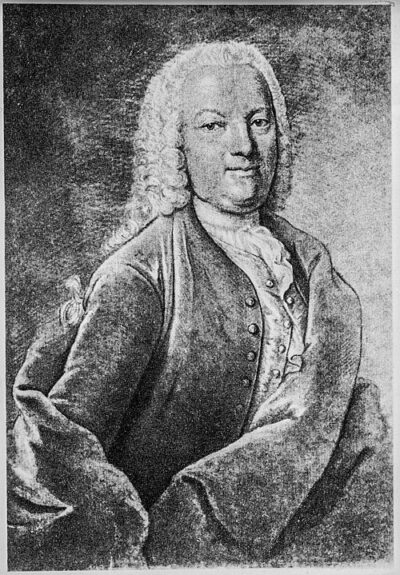
Johann Georg Pisendel
Johann Georg Pisendel was a German composer and violinist. Born December 26, 1687, in Cadolzburg. Died November 25, 1755, in Dresden. Educated at Thomasschule zu Leipzig.
Facts
13 facts · 1 confirmed by two sources · 6 cited · 5 from one source · 1 where the sources disagree
What’s different
- Born: we show December 26, 1687 (Sources disagree). Wikipedia says January 5, 1688
Where this comes from
Papalocal keeps its own record. It started from these sources; what each one said is kept here as it was copied, so a change on their side never changes this page by itself. Tap one to read its version.
What Wikidata says · copied November 17, 2026 · revision 2564006095
- Described as
- German composer and violinist
- Born
- December 26, 1687 · 6 references
- Died
- November 25, 1755 · 6 references
- Born in
- Cadolzburg · 1 reference
- Died in
- Dresden · 1 reference
- Citizen of
- Germany
- Occupation
- composer · 1 reference; violinist · 1 reference; conductor; concertmaster; music arranger · 1 reference; copyist · 1 reference
- Education
- Thomasschule zu Leipzig
- Instrument
- violin
- Wikipedias with a page
- 26
Wikidata item Q508635 (wikidata.org/wiki/Q508635), public domain (CC0). Copied November 17, 2026.
What Wikipedia says · copied November 17, 2026 · revision 1367105238
Johann Georg Pisendel (5 January 1688 [O.S. 26 December 1687] – 25 November 1755) was a German Baroque violinist and composer who, for many years, led the Court Orchestra in Dresden as concertmaster, then the finest instrumental ensemble in Europe. He was the leading violinist of his time, and composers such as Tomaso Albinoni, Georg Philipp Telemann and Antonio Vivaldi all dedicated violin compositions to him.
- Born, in its opening lines
- January 5, 1688
- Died, in its opening lines
- November 25, 1755
From the Wikipedia article “Johann Georg Pisendel” (en.wikipedia.org/wiki/Johann_Georg_Pisendel), by its contributors, under CC BY-SA 4.0 (creativecommons.org/licenses/by-sa/4.0/). Copied November 17, 2026; not changed.
Confirmed Two sources agree. Cited One source, and it names where it got it. One source One source, without a reference of its own. Sources disagree The sources disagree. We show the best-supported value and keep theirs below.
