
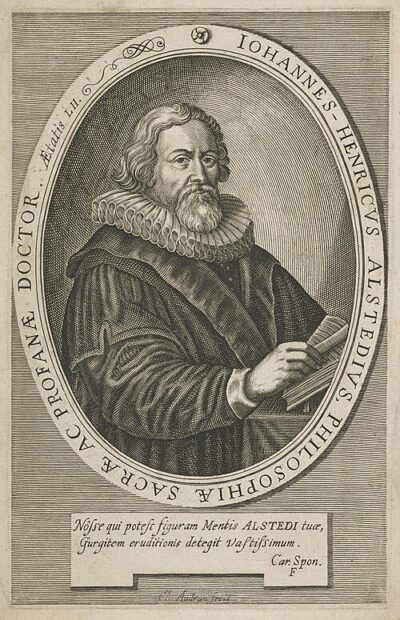
Johann Heinrich Alsted was a German theologist. Born March 1588, in Ballersbach. Died November 9, 1638, in Alba Iulia.
Facts
18 facts · 2 confirmed by two sources · 12 cited · 4 from one source
Where this comes from
Papalocal keeps its own record. It started from these sources; what each one said is kept here as it was copied, so a change on their side never changes this page by itself. Tap one to read its version.
What Wikidata says · copied November 18, 2026 · revision 2570655907
- Described as
- German theologist (1558-1638)
- Other names
- John Henry Alstedius, Alstedius
- Born
- March 1588 · 1 reference
- Died
- November 9, 1638
- Born in
- Ballersbach · 1 reference
- Died in
- Alba Iulia · 1 reference
- Citizen of
- Germany · 1 reference
- Occupation
- theologian · 1 reference; musicologist; writer; music theorist; university teacher · 1 reference; philosopher · 2 references; teacher · 1 reference; pedagogue · 1 reference
- Field
- philosophy · 1 reference; theology · 1 reference; science · 1 reference; encyclopedia · 1 reference
- Religion
- Protestantism
- Wikipedias with a page
- 23
Wikidata item Q454743 (wikidata.org/wiki/Q454743), public domain (CC0). Copied November 18, 2026.
What Wikipedia says · copied November 18, 2026 · revision 1339166508
Johann Heinrich Alsted (March 1588 – November 9, 1638), "the true parent of all the Encyclopædias", was a German-born Transylvanian Saxon Calvinist minister and academic, known for his varied interests: in Ramism and Lullism, pedagogy and encyclopedias, theology and millenarianism. His contemporaries noted that an anagram of Alstedius was sedulitas, meaning "hard work" in Latin.
- Born, in its opening lines
- March 1588
- Died, in its opening lines
- November 9, 1638
From the Wikipedia article “Johann Heinrich Alsted” (en.wikipedia.org/wiki/Johann_Heinrich_Alsted), by its contributors, under CC BY-SA 4.0 (creativecommons.org/licenses/by-sa/4.0/). Copied November 18, 2026; not changed.
Confirmed Two sources agree. Cited One source, and it names where it got it. One source One source, without a reference of its own. Sources disagree The sources disagree. We show the best-supported value and keep theirs below.
