
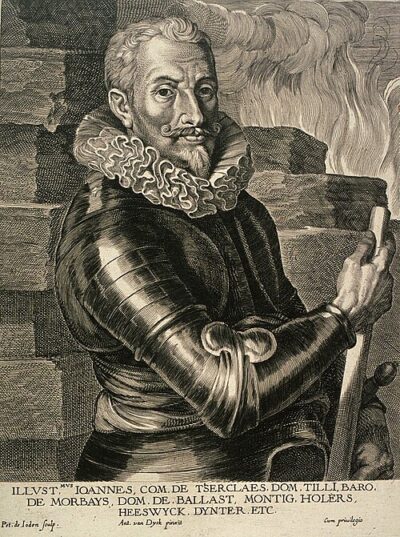
Johann Tserclaes, Count of Tilly
Johann Tserclaes, Count of Tilly was a field marshal who commanded the Catholic League's forces (1559-1632) in the Thirty Years' War. Born February 1559, in Tilly. Died April 30, 1632, in Ingolstadt.
Facts
14 facts · 2 confirmed by two sources · 6 cited · 5 from one source · 1 where the sources disagree
What’s different
- Cause of death: we show tetanus (Sources disagree). Wikidata also lists osteomyelitis
Where this comes from
Papalocal keeps its own record. It started from these sources; what each one said is kept here as it was copied, so a change on their side never changes this page by itself. Tap one to read its version.
What Wikidata says · copied November 16, 2026 · revision 2566516541
- Described as
- field marshal who commanded the Catholic League's forces (1559-1632) in the Thirty Years' War
- Other names
- Johann t'Serclaes Graf von Tilly, Johann Tserklaes, Count of Tilly
- Born
- February 1559 · 2 references
- Died
- April 30, 1632 · 4 references
- Born in
- Tilly · 1 reference
- Died in
- Ingolstadt · 2 references
- Buried in
- Stiftspfarrkirche St. Philipp und Jakob
- Cause of death
- tetanus; osteomyelitis
- Citizen of
- Germany · 1 reference
- Occupation
- military officer; military leader · 2 references
- Field
- military affairs · 1 reference
- Religion
- Catholicism
- Military branch
- Army of Flanders · 1 reference
- Military rank
- generalissimo; general · 2 references
- Wikipedias with a page
- 41
Wikidata item Q155534 (wikidata.org/wiki/Q155534), public domain (CC0). Copied November 16, 2026.
What Wikipedia says · copied November 16, 2026 · revision 1380032038
Johann Tserclaes, Count of Tilly (Dutch: Johan t'Serclaes Graaf van Tilly; German: Johann t'Serclaes Graf von Tilly; French: Jean t'Serclaes, comte de Tilly; February 1559 – 30 April 1632) was a field marshal who commanded the Catholic League's forces in the Thirty Years' War. From 1620 to 1631, he led a number of important imperial victories, including White Mountain, Wimpfen, Höchst, Stadtlohn and the Conquest of the Palatinate. He destroyed a Danish army at Lutter and sacked the Protestant city of Magdeburg, which caused the deaths of some 20,000 of the city's inhabitants, both defenders and non-combatants, out of a total population of 25,000.
However, Tilly's army was defeated at Breitenfeld in 1631 by the Swedish army of King Gustavus Adolphus. He then defeated the Swedish army at the Battle of Bamberg before a bullet from a Swedish arquebus mortally wounded him at the Battle of Rain on 15 April 1632, and he died two weeks later in Ingolstadt on 30 April 1632, at the age of 73. Along with Duke Albrecht von Wallenstein of Friedland and Mecklenburg, he was one of two chief commanders of the Holy Roman Empire's forces during the first half of the Thirty Years' War. Military historian Gaston Bodart (1908) refers to Tilly as one of the most notable military leaders from modern and contemporary times.
- Born, in its opening lines
- February 1559
- Died, in its opening lines
- April 30, 1632
From the Wikipedia article “Johann Tserclaes, Count of Tilly” (en.wikipedia.org/wiki/Johann_Tserclaes,_Count_of_Tilly), by its contributors, under CC BY-SA 4.0 (creativecommons.org/licenses/by-sa/4.0/). Copied November 16, 2026; not changed.
Confirmed Two sources agree. Cited One source, and it names where it got it. One source One source, without a reference of its own. Sources disagree The sources disagree. We show the best-supported value and keep theirs below.
