
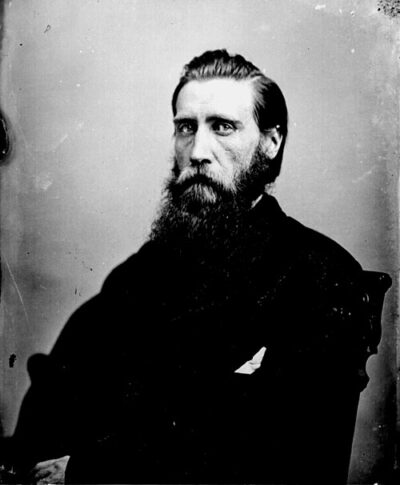
John Bell Hood
John Bell Hood was a Confederate general. Born June 29, 1831, in Owingsville. Died August 30, 1879, in New Orleans. Educated at United States Military Academy.
Facts
14 facts · 0 confirmed by two sources · 2 cited · 10 from one source · 2 where the sources disagree
What’s different
- Born: we show June 29, 1831 (Sources disagree). Wikipedia says June 1, 1831
- Died: we show August 30, 1879 (Sources disagree). Wikipedia says August 31, 1879
Where this comes from
Papalocal keeps its own record. It started from these sources; what each one said is kept here as it was copied, so a change on their side never changes this page by itself. Tap one to read its version.
What Wikidata says · copied November 16, 2026 · revision 2518394622
- Described as
- Confederate general (1831–1879)
- Other names
- John B. Hood, John Hood, J. B. Hood
- Born
- June 29, 1831 · 2 references
- Died
- August 30, 1879 · 3 references
- Born in
- Owingsville
- Died in
- New Orleans
- Buried in
- Metairie Cemetery · 1 reference
- Cause of death
- yellow fever
- Citizen of
- United States
- Occupation
- military personnel
- Education
- United States Military Academy
- Father
- John W. Hood
- Mother
- Theodocia Hood · 1 reference
- Military branch
- United States Army · 1 reference; Provisional Army of the Confederate States (1861–1865)
- Military rank
- general
- Wikipedias with a page
- 23
Wikidata item Q553533 (wikidata.org/wiki/Q553533), public domain (CC0). Copied November 16, 2026.
What Wikipedia says · copied November 16, 2026 · revision 1380688609
John Bell Hood (June 1, 1831 – August 31, 1879) was a Confederate general during the American Civil War.
Hood's education at the United States Military Academy led to a career as a junior officer in the infantry and cavalry of the antebellum U.S. Army in California and Texas. At the start of the Civil War, he offered his services to his adopted state of Texas. He achieved his reputation for aggressive leadership as a brigade commander in the army of Robert E. Lee during the Seven Days Battles in 1862, after which he was promoted to division command. He led a division under James Longstreet in the campaigns of 1862–63. At the Battle of Gettysburg, he was severely wounded, rendering his left arm mostly useless for the rest of his life. Transferred with many of Longstreet's troops to the Western Theater, Hood led a massive assault into a gap in the Union line at the Battle of Chickamauga but was wounded again, requiring the amputation of his right leg.
Hood returned to field service during the Atlanta Campaign of 1864 and, at the age of 33, was promoted to temporary full general and command of the Army of Tennessee at the outskirts of Atlanta, making him the youngest soldier on either side of the war to be given command of an army. There, he dissipated his army in a series of unsuccessful assaults and was forced to evacuate the besieged city. Leading his men through Alabama and into Tennessee, his army was severely damaged in a massive frontal assault at the Battle of Franklin. He was decisively defeated at the Battle of Nashville by his former West Point instructor, Major General George Henry Thomas, after which he was relieved of command.
Hood's impulsiveness led to high losses among the troops under his command, especially as he moved up in the Confederate ranks. Bruce Catton wrote that "the decision to replace Johnston with Hood was probably the single largest mistake that either government made during the war."
After the war, Hood moved to Louisiana and worked as a cotton broker and in the insurance business. His business was ruined by a yellow fever epidemic in New Orleans during the winter of 1878–79. He succumbed to the disease, dying just days after his wife and oldest child, leaving ten destitute orphans.
- Born, in its opening lines
- June 1, 1831
- Died, in its opening lines
- August 31, 1879
From the Wikipedia article “John Bell Hood” (en.wikipedia.org/wiki/John_Bell_Hood), by its contributors, under CC BY-SA 4.0 (creativecommons.org/licenses/by-sa/4.0/). Copied November 16, 2026; not changed.
Confirmed Two sources agree. Cited One source, and it names where it got it. One source One source, without a reference of its own. Sources disagree The sources disagree. We show the best-supported value and keep theirs below.
