
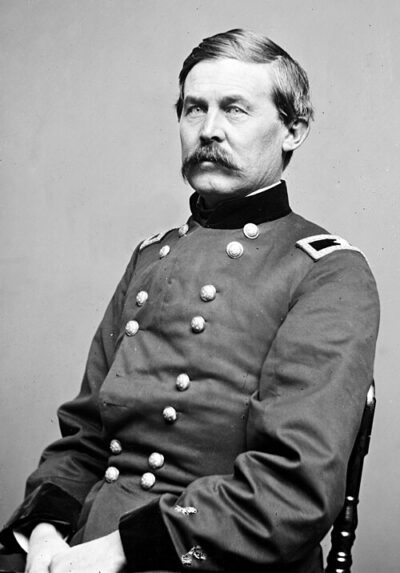
John Buford
John Buford was an Union Army General. Born March 4, 1826, in Woodford County. Died December 16, 1863, in Washington, D.C.. Educated at Knox College and United States Military Academy.
Facts
12 facts · 2 confirmed by two sources · 0 cited · 10 from one source
Where this comes from
Papalocal keeps its own record. It started from these sources; what each one said is kept here as it was copied, so a change on their side never changes this page by itself. Tap one to read its version.
What Wikidata says · copied November 18, 2026 · revision 2520947057
- Described as
- Union Army General (1826-1863)
- Other names
- John Buford, Jr.
- Born
- March 4, 1826 · 2 references
- Died
- December 16, 1863 · 2 references
- Born in
- Woodford County
- Died in
- Washington, D.C.
- Buried in
- West Point Cemetery
- Citizen of
- United States
- Occupation
- military officer
- Education
- Knox College; United States Military Academy
- Military branch
- Union Army; United States Army
- Military rank
- major general
- Wikipedias with a page
- 19
Wikidata item Q540971 (wikidata.org/wiki/Q540971), public domain (CC0). Copied November 18, 2026.
What Wikipedia says · copied November 18, 2026 · revision 1379818249
John Buford Jr. (March 4, 1826 – December 16, 1863) was a United States Army cavalry officer. He fought for the Union during the American Civil War, rising to the rank of major general. Buford is best known for his actions in the first day of the Battle of Gettysburg on July 1, 1863, by identifying Cemetery Hill and Cemetery Ridge as high ground that would be crucial in the impending battle, and by placing vedettes (the cavalry equivalent of "picket lines") to the west and north that delayed the enemy long enough for the Union Army to arrive.
Born in the divided border state of Kentucky, Buford graduated from West Point in 1848. He remained loyal to the United States when the Civil War broke out and fought against the Confederate Army of Northern Virginia as part of the Army of the Potomac. His first command was a cavalry brigade under Major General John Pope. He distinguished himself at Second Bull Run in August 1862, where he was wounded. He also saw action at Antietam in September and during Stoneman's Raid in spring 1863.
Buford's cavalry division played a crucial role in the Gettysburg campaign that summer. Arriving at the small town of Gettysburg, Pennsylvania, on June 30, before the Confederate troops, Buford set up defensive positions. On the morning of July 1, Buford's division was attacked by a Confederate division under the command of Major General Henry Heth. His men held just long enough for Union reinforcements to arrive. After a massive three-day battle, the Union troops emerged victorious. Later, Buford rendered valuable service to the Army, both in the pursuit of Robert E. Lee after the Battle of Gettysburg, and in the Bristoe Campaign that autumn, but his health started to fail, possibly from typhoid. Just before his death at age 37, he received a personal message from President Abraham Lincoln, promoting him to major general of volunteers in recognition of his tactical skill and leadership displayed on the first day of Gettysburg.
- Born, in its opening lines
- March 4, 1826
- Died, in its opening lines
- December 16, 1863
From the Wikipedia article “John Buford” (en.wikipedia.org/wiki/John_Buford), by its contributors, under CC BY-SA 4.0 (creativecommons.org/licenses/by-sa/4.0/). Copied November 18, 2026; not changed.
Confirmed Two sources agree. Cited One source, and it names where it got it. One source One source, without a reference of its own. Sources disagree The sources disagree. We show the best-supported value and keep theirs below.
