
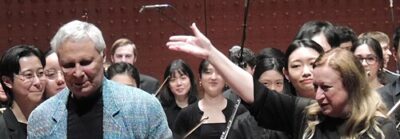
John Corigliano
John Corigliano is an American composer. Born February 16, 1938, in Brooklyn. Educated at Columbia University and Manhattan School of Music. Awards include Guggenheim Fellowship, Rome Prize and Academy Award for Best Original Score.
Facts
33 facts · 1 confirmed by two sources · 22 cited · 10 from one source
Where this comes from
Papalocal keeps its own record. It started from these sources; what each one said is kept here as it was copied, so a change on their side never changes this page by itself. Tap one to read its version.
What Wikidata says · copied November 15, 2026 · revision 2567401949
- Described as
- American composer (born 1938)
- Other names
- John Paul Corigliano, Ioannes Corigliano, Ioannis Corigliano, I. Corigliano, Corigliano, Ioannes, Corigliano, Ioannis, Corigliano, 00006789268 IPI, John P. Corigliano, J. P. Corigliano, Corigliano, John Paul, Корильяно, Джон
- Born
- February 16, 1938 · 7 references
- Born in
- Brooklyn · 1 reference
- Citizen of
- United States
- Occupation
- classical composer · 1 reference; university teacher · 1 reference; concertmaster · 1 reference; film score composer · 1 reference; professor of music composition · 1 reference; composer · 1 reference
- Worked for
- City University of New York; New York University · 1 reference; Juilliard School · 2 references
- Education
- Columbia University; Manhattan School of Music; Midwood High School
- Member of
- American Academy of Arts and Letters (1991–) · 1 reference
- Genre
- classical music · 1 reference; symphonic music · 1 reference; concerto · 1 reference; chamber music · 1 reference; opera · 1 reference; film score · 1 reference
- Instrument
- piano
- Awards
- Guggenheim Fellowship (1968) · 1 reference; Rome Prize; Academy Award for Best Original Score (2000) · 2 references; Pulitzer Prize for Music (2001) · 1 reference; Grawemeyer Award for Music Composition (1991) · 2 references; Arts and Letters Award in Music (1989) · 1 reference; honorary doctor of the University of Miami (2002) · 1 reference; John Jay Award
- Father
- John Corigliano · 1 reference
- Website
- http://www.johncorigliano.com · 1 reference
- Wikipedias with a page
- 24
Wikidata item Q450620 (wikidata.org/wiki/Q450620), public domain (CC0). Copied November 15, 2026.
What Wikipedia says · copied November 15, 2026 · revision 1381546514
John Paul Corigliano (born February 16, 1938) is an American composer of contemporary classical music. With over 100 compositions, he has won accolades including a Pulitzer Prize, five Grammy Awards, the Grawemeyer Award for Music Composition, and an Academy Award.
He is a former distinguished professor of music at Lehman College and the Graduate Center of the City University of New York and part of the composition faculty at the Juilliard School. Corigliano is best known for his Symphony No. 1, a response to the AIDS epidemic, and his film score for François Girard's The Red Violin (1997), which he adapted as his 2003 Concerto for Violin and Orchestra ("The Red Violin") for Joshua Bell.
- Born, in its opening lines
- February 16, 1938
From the Wikipedia article “John Corigliano” (en.wikipedia.org/wiki/John_Corigliano), by its contributors, under CC BY-SA 4.0 (creativecommons.org/licenses/by-sa/4.0/). Copied November 15, 2026; not changed.
Confirmed Two sources agree. Cited One source, and it names where it got it. One source One source, without a reference of its own. Sources disagree The sources disagree. We show the best-supported value and keep theirs below.
