
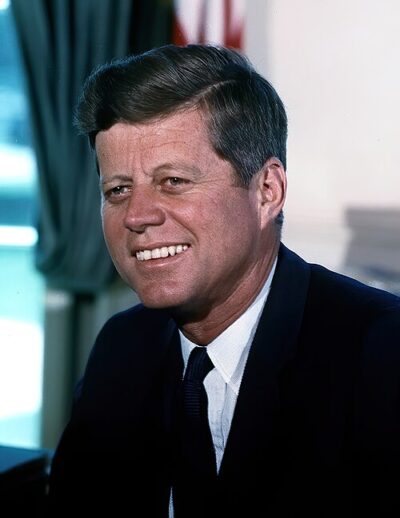
John F. Kennedy
John F. Kennedy was a president of the United States from 1961 to 1963. Born May 29, 1917, in John Fitzgerald Kennedy National Historic Site. Died November 22, 1963, in Parkland Memorial Hospital. Positions held include President of the United States (1961–1963), United States representative (1947–1953) and United States senator (1953–1960). Known for We choose to go to the Moon, Ich bin ein Berliner and Profiles in Courage. Educated at Harvard College and Choate Rosemary Hall. Awards include Navy and Marine Corps Medal, Purple Heart and American Defense Service Medal.
Facts
73 facts · 2 confirmed by two sources · 47 cited · 24 from one source
Where this comes from
Papalocal keeps its own record. It started from these sources; what each one said is kept here as it was copied, so a change on their side never changes this page by itself. Tap one to read its version.
What Wikidata says · copied November 13, 2026 · revision 2567999014
- Described as
- president of the United States from 1961 to 1963 (1917–1963)
- Other names
- Kennedy, John F Kennedy, President Kennedy, John Fitzgerald "Jack" Kennedy, JF Kennedy, John Kennedy, J. F. Kennedy, JFK, Jack Kennedy, John Fitzgerald Kennedy
- Born
- May 29, 1917 · 18 references
- Died
- November 22, 1963 · 17 references
- Born in
- John Fitzgerald Kennedy National Historic Site · 4 references
- Died in
- Parkland Memorial Hospital · 2 references
- Buried in
- Arlington National Cemetery (1963) · 1 reference
- Cause of death
- shot to the head
- Name at birth
- John Fitzgerald Kennedy · 1 reference
- Citizen of
- United States
- Occupation
- politician · 1 reference; journalist; statesperson; writer · 1 reference; naval officer; anti-communist
- Positions held
- President of the United States (1961–1963) · 1 reference; United States representative (1947–1953); United States senator (1953–1960) · 1 reference; President-elect of the United States (1960–1961)
- Political party
- Democratic Party · 2 references
- Education
- Harvard College (1936–1940) · 5 references; Choate Rosemary Hall (1931–1935) · 3 references; Riverdale Country School · 2 references; Stanford Graduate School of Business (1940–1941) · 5 references; Princeton University (1935–1936) · 3 references; Edward Devotion School (1922–)
- Member of
- American Academy of Arts and Sciences; American Legion; Veterans of Foreign Wars
- Known for
- We choose to go to the Moon (1962); Ich bin ein Berliner (1963); Profiles in Courage (1955)
- Awards
- Navy and Marine Corps Medal (1944) · 3 references; Purple Heart (1943) · 1 reference; American Defense Service Medal (1945) · 1 reference; American Campaign Medal (1945) · 1 reference; Asiatic-Pacific Campaign Medal (1945) · 1 reference; World War II Victory Medal (1945) · 1 reference; Pacem in Terris Award; Grand Officer of the Order of Merit of the Italian Republic (1957) · 1 reference; Presidential Medal of Freedom (1963) · 1 reference; Pulitzer Prize for Biography (1957) · 2 references; Grand Officer of the Order of the Star of Italian Solidarity (1951) · 1 reference; Laetare Medal (1961) · 1 reference; Time Person of the Year (1961) · 2 references; Jane Addams Children's Book Award (1964); James Cardinal Gibbons Medal
- Field
- politician · 1 reference; opinion journalist · 1 reference; military personnel · 1 reference
- Spouse
- Jacqueline Kennedy Onassis (1953–1963) · 3 references
- Children
- John F. Kennedy Jr. · 1 reference; Patrick Bouvier Kennedy · 2 references; Arabella Kennedy · 1 reference; Caroline Kennedy · 2 references
- Father
- Joseph P. Kennedy Sr. · 2 references
- Mother
- Rose Kennedy · 2 references
- Siblings
- Joseph P. Kennedy Jr. · 1 reference; Rosemary Kennedy · 1 reference; Kathleen Cavendish · 1 reference; Eunice Kennedy Shriver · 1 reference; Patricia Kennedy Lawford · 1 reference; Robert F. Kennedy · 1 reference; Jean Kennedy Smith · 1 reference; Ted Kennedy · 1 reference
- Religion
- Catholicism · 2 references
- Military branch
- United States Navy (1941–1945) · 2 references
- Military rank
- lieutenant (1943–1945) · 2 references; lieutenant (junior grade) (1942–1943) · 1 reference; ensign (1941–1942) · 1 reference
- Lived in
- John Fitzgerald Kennedy National Historic Site (1917–1920) · 1 reference
- Nickname
- Jack · 1 reference
- Height
- 1.85 m (6 ft 1 in) · 1 reference
- Website
- https://www.whitehouse.gov/about-the-white-house/presidents/john-f-kennedy/ · 2 references
- Wikipedias with a page
- 252
Wikidata item Q9696 (wikidata.org/wiki/Q9696), public domain (CC0). Copied November 13, 2026.
What Wikipedia says · copied November 13, 2026 · revision 1384882974
John Fitzgerald Kennedy (May 29, 1917 – November 22, 1963), also known as JFK, was the 35th president of the United States, serving from 1961 until his assassination in 1963. A member of the Democratic Party, he represented Massachusetts in both houses of the U.S. Congress before his presidency. Kennedy was the youngest elected president at 43 years, and the first Roman Catholic president.
Born into the prominent Kennedy family in Brookline, Massachusetts, Kennedy graduated from Harvard University in 1940, joining the U.S. Naval Reserve the following year. During World War II, he commanded PT boats in the Pacific theater. Kennedy's survival following the sinking of PT-109 and his rescue of his fellow sailors made him a war hero and earned the Navy and Marine Corps Medal, but left him with serious injuries. After a brief stint in journalism, Kennedy represented a working-class Boston district in the U.S. House of Representatives from 1947 to 1953. He was subsequently elected to the U.S. Senate, serving as the junior senator from Massachusetts from 1953 to 1960. While in the Senate, Kennedy published his book Profiles in Courage, which won a Pulitzer Prize. Kennedy ran in the 1960 presidential election. His campaign gained momentum after the first televised presidential debates in American history, and he was elected president, narrowly defeating Republican opponent Richard Nixon, the incumbent vice president.
Kennedy's presidency saw high tensions with communist states in the Cold War. He increased the number of American military advisers in South Vietnam, and the Strategic Hamlet Program began during his presidency. In 1961, he authorized attempts to overthrow the Cuban government of Fidel Castro in the failed Bay of Pigs Invasion and Operation Mongoose. In October 1962, U.S. spy planes discovered Soviet missile bases had been deployed in Cuba. The resulting period of tensions, termed the Cuban Missile Crisis, nearly resulted in nuclear war. In August 1961, after East German troops erected the Berlin Wall, Kennedy sent an army convoy to reassure West Berliners of U.S. support, and delivered one of his most famous speeches in West Berlin in June 1963. In 1963, Kennedy signed the first nuclear weapons treaty. He presided over the establishment of the Peace Corps, Alliance for Progress with Latin America, and the continuation of the Apollo program with the goal of landing a man on the Moon before 1970. He supported the civil rights movement but was only somewhat successful in passing his New Frontier domestic policies.
On November 22, 1963, Kennedy was assassinated in Dallas. His vice president, Lyndon B. Johnson, assumed the presidency. Lee Harvey Oswald was arrested for the assassination, but Jack Ruby shot and killed him two days later. The Federal Bureau of Investigation (FBI) and the Warren Commission both concluded Oswald had acted alone, but conspiracy theories about the assassination persist. After Kennedy's death, Congress enacted many of his proposals, including the Civil Rights Act of 1964 and the Revenue Act of 1964. He ranks highly in polls of U.S. presidents with historians and the general public. His personal life has been the focus of considerable sustained interest following public revelations in the 1970s of his chronic health ailments and extramarital affairs. Kennedy is the most recent U.S. president to have died in office.
- Born, in its opening lines
- May 29, 1917
- Died, in its opening lines
- November 22, 1963
From the Wikipedia article “John F. Kennedy” (en.wikipedia.org/wiki/John_F._Kennedy), by its contributors, under CC BY-SA 4.0 (creativecommons.org/licenses/by-sa/4.0/). Copied November 13, 2026; not changed.
Confirmed Two sources agree. Cited One source, and it names where it got it. One source One source, without a reference of its own. Sources disagree The sources disagree. We show the best-supported value and keep theirs below.
