
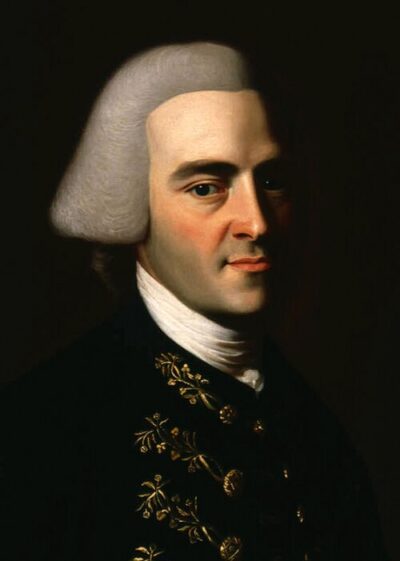
John Hancock
John Hancock was an American Patriot and statesman during the American Revolution. Born January 23, 1737, in Braintree. Died October 8, 1793, in Hancock Manor. Positions held include President of the Continental Congress (1775–1777) and Governor of Massachusetts (2 times) (1780–1793). Educated at Boston Latin School and Harvard College. Awards include Fellow of the American Academy of Arts and Sciences.
Facts
25 facts · 2 confirmed by two sources · 5 cited · 18 from one source
Where this comes from
Papalocal keeps its own record. It started from these sources; what each one said is kept here as it was copied, so a change on their side never changes this page by itself. Tap one to read its version.
What Wikidata says · copied November 13, 2026 · revision 2557989997
- Described as
- American Patriot and statesman during the American Revolution (1737–1793)
- Other names
- John Hancock III
- Born
- January 23, 1737 · 3 references
- Died
- October 8, 1793 · 8 references
- Born in
- Braintree
- Died in
- Hancock Manor
- Buried in
- Granary Burying Ground
- Citizen of
- United States
- Occupation
- merchant; statesperson; entrepreneur; politician · 2 references
- Positions held
- President of the Continental Congress (1775–1777); Governor of Massachusetts (2 times) (1780–1793)
- Education
- Boston Latin School (–1750) · 1 reference; Harvard College (–1754)
- Member of
- American Academy of Arts and Sciences
- Awards
- Fellow of the American Academy of Arts and Sciences (1780–) · 1 reference
- Field
- politics · 1 reference; entrepreneurship · 1 reference
- Spouse
- Dorothy Quincy (1775–1793)
- Children
- Lydia Henchman Hancock; John George Washington Hancock · 1 reference
- Father
- John Hancock, Jr.
- Mother
- Mary Hawke · 1 reference
- Siblings
- Ebenezer Hancock
- Religion
- Congregational churches
- Wikipedias with a page
- 47
Wikidata item Q272774 (wikidata.org/wiki/Q272774), public domain (CC0). Copied November 13, 2026.
What Wikipedia says · copied November 13, 2026 · revision 1384713173
John Hancock (January 23, 1737 [O.S. January 12, 1736] – October 8, 1793) was an American Founding Father, merchant, statesman, and prominent Patriot of the American Revolution. He was the longest-serving president of the Continental Congress, having served as the second president of the Second Continental Congress and the seventh president of the Congress of the Confederation. He was the first and third governor of the Commonwealth of Massachusetts. His large and stylish signature on the United States Declaration of Independence led to John Hancock or Hancock becoming a colloquialism for a person's signature. He also signed the Articles of Confederation, and used his influence to ensure that Massachusetts ratified the United States Constitution in 1788.
Before the American Revolution, Hancock was one of the wealthiest men in the Thirteen Colonies, having inherited a profitable mercantile business from his uncle. He began his political career in Boston as a protégé of Samuel Adams, an influential local politician, though the two men later became estranged. Hancock used his wealth to support the colonial cause as tensions increased between colonists and Great Britain in the 1760s. He became very popular in Massachusetts, especially after Boston customs officials seized his sloop Liberty in 1768 and charged him with smuggling. Those charges were eventually dropped; he has often been described as a smuggler in historical accounts, but the accuracy of this characterization has been questioned.
- Born, in its opening lines
- January 23, 1737
- Died, in its opening lines
- October 8, 1793
From the Wikipedia article “John Hancock” (en.wikipedia.org/wiki/John_Hancock), by its contributors, under CC BY-SA 4.0 (creativecommons.org/licenses/by-sa/4.0/). Copied November 13, 2026; not changed.
Confirmed Two sources agree. Cited One source, and it names where it got it. One source One source, without a reference of its own. Sources disagree The sources disagree. We show the best-supported value and keep theirs below.
