
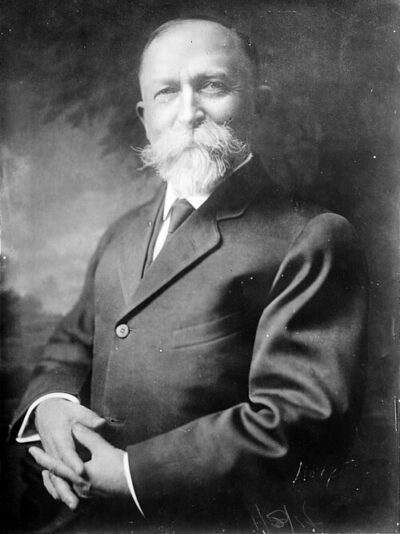
John Harvey Kellogg
John Harvey Kellogg was an American physician. Born February 26, 1852, in Tyrone Township. Died December 14, 1943, in Battle Creek. Educated at New York University and Bellevue Hospital Center. Awards include National Inventors Hall of Fame.
Facts
25 facts · 2 confirmed by two sources · 10 cited · 13 from one source
Where this comes from
Papalocal keeps its own record. It started from these sources; what each one said is kept here as it was copied, so a change on their side never changes this page by itself. Tap one to read its version.
What Wikidata says · copied November 15, 2026 · revision 2567385959
- Described as
- American physician (1852–1943)
- Other names
- John H. Kellogg, Corn flakes Battle Creek Sanitarium Kellanova (Kellogg's)
- Born
- February 26, 1852 · 8 references
- Died
- December 14, 1943 · 7 references
- Born in
- Tyrone Township · 1 reference
- Died in
- Battle Creek
- Buried in
- Oak Hill Cemetery · 1 reference
- Citizen of
- United States
- Occupation
- physician · 1 reference; nutritionist; businessperson · 1 reference; inventor · 1 reference
- Education
- New York University; Bellevue Hospital Center; Grossman School of Medicine; Eastern Michigan University
- Member of
- American Association for the Advancement of Science · 1 reference
- Awards
- National Inventors Hall of Fame (2006) · 1 reference
- Field
- alternative medicine; medicine · 1 reference; human nutrition · 1 reference; holistic health · 1 reference
- Spouse
- Ella Eaton Kellogg
- Father
- John Preston Kellogg · 1 reference
- Mother
- Ann Janette Stanley · 1 reference
- Siblings
- Will Keith Kellogg
- Religion
- Seventh-day Adventist Church
- Wikipedias with a page
- 34
Wikidata item Q380036 (wikidata.org/wiki/Q380036), public domain (CC0). Copied November 15, 2026.
What Wikipedia says · copied November 15, 2026 · revision 1384230120
John Harvey Kellogg (February 26, 1852 – December 14, 1943) was an American businessman, inventor, physician, and advocate of the health reforms advocated by the Battle Creek Progressive Friends movement and the eugenics policies espoused by many in the Progressive Movement. He was the director of the Battle Creek Sanitarium in Battle Creek, Michigan, founded by members of the Seventh-day Adventist Church. It combined aspects of a European spa, a hydrotherapy institution, a hospital, and a high-class hotel. Kellogg treated the rich and famous, as well as the poor who could not afford other hospitals. According to Encyclopædia Britannica, he "developed numerous nut and vegetable products to vary the diet of the patients, including a flaked-wheat cereal called Granose and cornflakes. Although cornflakes were not new, they had never before been presented as a breakfast food [...] Kellogg was [also] a cofounder of the Race Betterment Foundation, an organization that promoted eugenics and racial segregation."
An early proponent of the germ theory of disease, Kellogg was well ahead of his time in relating intestinal flora and the presence of bacteria in the intestines to health and disease. The sanitarium approached treatment in a holistic manner, actively promoting vegetarianism, nutrition, the use of yogurt enemas to clear "intestinal flora", exercise, sun-bathing, and hydrotherapy, as well as abstinence from smoking tobacco, drinking alcoholic beverages, and sexual activity. Kellogg dedicated the last 30 years of his life to promoting eugenics and racial segregation. Kellogg was a major leader in progressive health reform, particularly in the second phase of the clean living movement. He wrote extensively on science and health. His approach to "biologic living" combined scientific knowledge with Adventist beliefs and the promotion of health reform and temperance. Many of the vegetarian foods that Kellogg developed and offered his patients were publicly marketed: Kellogg's brother, Will Keith Kellogg, is best known today for the invention of the breakfast cereal corn flakes.
Kellogg held liberal Christian theological beliefs radically different from mainstream Nicene Christianity and emphasized what he saw as the importance of human reason over many aspects of traditional doctrinal authority. He strongly rejected fundamentalist and conservative notions of original sin, human depravity, and the atonement of Jesus, viewing the last in terms of "his exemplary life" on Earth rather than death. Kellogg was a Seventh-day Adventist (SDA) as the group's beliefs shifted towards Trinitarianism during the 1890s, and Adventists were "unable to accommodate the essentially liberal understanding of Christianity" exhibited by Kellogg, viewing his theology as pantheistic and unorthodox. His disagreements with other members of the SDA Church led to a major schism: he was disfellowshipped in 1907, but continued to adhere to many of the church's beliefs and directed the sanitarium until his death. Kellogg helped to establish the American Medical Missionary College in 1895. Popular misconceptions have wrongly attributed various cultural practices, inventions, and historical events to Kellogg.
- Born, in its opening lines
- February 26, 1852
- Died, in its opening lines
- December 14, 1943
From the Wikipedia article “John Harvey Kellogg” (en.wikipedia.org/wiki/John_Harvey_Kellogg), by its contributors, under CC BY-SA 4.0 (creativecommons.org/licenses/by-sa/4.0/). Copied November 15, 2026; not changed.
Confirmed Two sources agree. Cited One source, and it names where it got it. One source One source, without a reference of its own. Sources disagree The sources disagree. We show the best-supported value and keep theirs below.
