
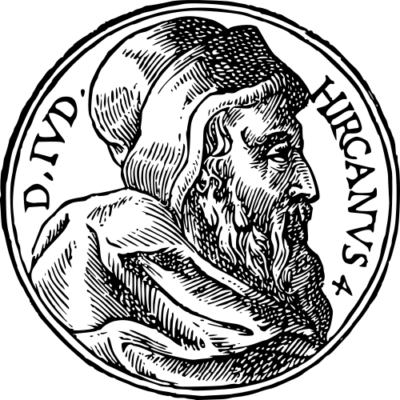
John Hyrcanus
John Hyrcanus was a Hasmonean ruler. Born 2nd century BC. Died 104 BC. Positions held include High Priest of Israel (-134–-104).
Facts
11 facts · 0 confirmed by two sources · 2 cited · 9 from one source
Where this comes from
Papalocal keeps its own record. It started from these sources; what each one said is kept here as it was copied, so a change on their side never changes this page by itself. Tap one to read its version.
What Wikidata says · copied November 16, 2026 · revision 2565497607
- Described as
- Hasmonean ruler
- Born
- 2nd century BC
- Died
- 104 BC
- Citizen of
- Hasmonean Judea
- Occupation
- priest
- Positions held
- High Priest of Israel (-134–-104)
- Children
- Alexander Jannaeus · 1 reference; Aristobulus I; Antigonus I; Absalom ben Johanan · 1 reference
- Father
- Simon Thassi
- Siblings
- Judas
- Wikipedias with a page
- 35
Wikidata item Q319043 (wikidata.org/wiki/Q319043), public domain (CC0). Copied November 16, 2026.
What Wikipedia says · copied November 16, 2026 · revision 1385153720
John Hyrcanus (; Hebrew: יוחנן הרקנוס, romanized: Yoḥānān Hurqanos; Koine Greek: Ἰωάννης Ὑρκανός, romanized: Iōánnēs Hyrkanós) was a Jewish high priest and ruler of Judea from the Hasmonean dynasty (born 164 BCE, reigned from 134 BCE until he died in 104 BCE). In rabbinic literature he is often referred to as Yoḥanan Cohen Gadol (יוחנן כהן גדול), "John the High Priest". John combined political and religious authority and secured Judea's independence from Seleucid control. His reign consolidated the Hasmonean state, expanded its territorial boundaries, and incorporated neighboring populations, laying the foundation for the policies and territorial expansions of subsequent Hasmonean rulers.
Hyrcanus assumed power following the assassination of his father, Simon Thassi, a brother of Judas Maccabeus, by Ptolemy ben Abubus near Jericho. He escaped the attack that killed his father and some of his brothers and was accepted as high priest in Jerusalem. Initially, he maintained relations with the Seleucid Empire, paying tribute while preserving autonomy and participating in military campaigns under Antiochus VII Sidetes, including operations against the Parthians. However, after Antiochus VII's death in 129 BCE, Hyrcanus ceased tribute payments and acted independently, establishing the de facto sovereignty of Judea.
During his reign, Hyrcanus conducted military campaigns to expand Hasmonean territory, which until then was largely confined to central Judea. He captured the regions of Samaria and Idumaea, destroyed the Samaritan temple at Mount Gerizim, and incorporated the Idumaean population, requiring conversion to Judaism. He also extended Hasmonean control over parts of Transjordan and Galilee. Hyrcanus is the first attested Hasmonean ruler to employ foreign troops, and he may have founded Hyrcania, a fortress in the Judaean Desert that bears his name.
Hyrcanus's policies and territorial expansions laid the foundation for the subsequent reigns of his sons, Aristobulus I and Alexander Jannaeus, who assumed the title of king alongside that of high priest.
From the Wikipedia article “John Hyrcanus” (en.wikipedia.org/wiki/John_Hyrcanus), by its contributors, under CC BY-SA 4.0 (creativecommons.org/licenses/by-sa/4.0/). Copied November 16, 2026; not changed.
Confirmed Two sources agree. Cited One source, and it names where it got it. One source One source, without a reference of its own. Sources disagree The sources disagree. We show the best-supported value and keep theirs below.
