
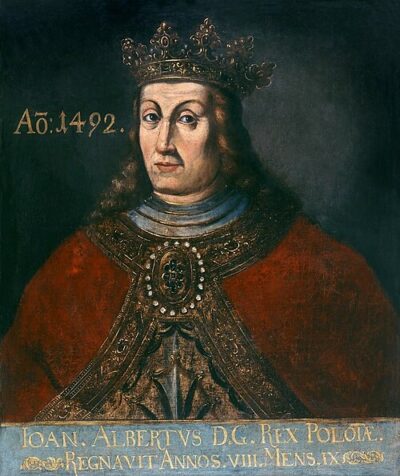
John I Albert was a King of Poland. Born December 27, 1459, in Kraków. Died June 17, 1501, in Toruń. Positions held include King of Poland (1492–1501).
Facts
20 facts · 2 confirmed by two sources · 4 cited · 14 from one source
Where this comes from
Papalocal keeps its own record. It started from these sources; what each one said is kept here as it was copied, so a change on their side never changes this page by itself. Tap one to read its version.
What Wikidata says · copied November 16, 2026 · revision 2557966728
- Described as
- King of Poland
- Other names
- Johann I Albrecht, King of Poland
- Born
- December 27, 1459 · 2 references
- Died
- June 17, 1501 · 2 references
- Born in
- Kraków · 2 references
- Died in
- Toruń · 2 references
- Buried in
- Wawel Cathedral
- Citizen of
- Poland
- Occupation
- politician
- Positions held
- King of Poland (1492–1501)
- Father
- Casimir IV Jagiellon · 1 reference
- Mother
- Elisabeth of Habsburg · 1 reference
- Siblings
- Anna Jagiellon; Barbara Jagiellon; Sophia Jagiellon, Margravine of Brandenburg-Ansbach; Hedwig Jagiellon, Duchess of Bavaria; Elizabeth Jagiellon; Vladislaus II of Bohemia and Hungary; Saint Casimir; Alexander Jagiellon; Sigismund I the Old; Elizabeth Jagellon · 1 reference
- Wikipedias with a page
- 42
Wikidata item Q53451 (wikidata.org/wiki/Q53451), public domain (CC0). Copied November 16, 2026.
What Wikipedia says · copied November 16, 2026 · revision 1377861753
John I Albert (Polish: Jan I Olbracht; 27 December 1459 – 17 June 1501) was King of Poland and (disputed) Supreme Duke of Lithuania from 1492 to his death, as well as Duke of Głogów from 1491 to 1498. He was the fourth Polish sovereign from the Jagiellonian dynasty and the son of Casimir IV and Elizabeth of Austria.
Related to the House of Habsburg, John Albert was groomed to become emperor in the Holy Roman Empire, a plan that ultimately failed. He was well-educated and tutored by scholars such as Johannes Longinus and Callimachus, whom he had subsequently befriended. Heavily influenced by the Italian Renaissance, John sought to strengthen royal authority at the expense of the Catholic Church and the clergy. In 1487, he led a force against the Ottoman Empire and defeated the Tatars of the Crimean Khanate during the early phase of the Polish–Ottoman War. In the aftermath of the Bohemian–Hungarian War, John Albert attempted to usurp Hungary from his elder brother Vladislaus, but on 20 February 1491, he renounced his claim to Hungary in exchange for the Duchy of Głogów and the suzerainty over half of Silesia.
Casimir died in 1492, and John was passed over as the Grand Duke of Lithuania in favour of his younger Alexander, thus de facto breaking the personal union between the two nations, though John claimed the position of Supreme Duke. John was elected as the King of Poland on 27 August of the same year, after which to secure his succession to the Polish throne he had dispatched an army against the Piast princes from the Duchy of Masovia, which ensured his victory but alienated the higher nobles and magnates. He later invaded Masovia to deprive Konrad III of his ancestral holdings and curtail internal opposition to his rule. In 1497, John Albert launched a personal crusade into Moldavia to uphold Polish suzerainty, establish control over Black Sea ports and dethrone Stephen III in favour of John Albert's brother Sigismund. The campaign's failure greatly hindered Polish expansion into Southern Europe, preventing any significant further expansion.
John Albert remains a largely forgotten and overlooked figure in the history of Poland, his relatively short reign ended in a major military setback, and he was criticised during his lifetime for embracing absolutism as well as attempting to centralise the government. He is credited for creating a bicameral parliament, comprising the Senate and the Sejm, which granted lower-class gentry the right of expression in the matters of state. Conversely, he limited the movement of serfs by confining them to nobles' estates.
- Born, in its opening lines
- December 27, 1459
- Died, in its opening lines
- June 17, 1501
From the Wikipedia article “John I Albert” (en.wikipedia.org/wiki/John_I_Albert), by its contributors, under CC BY-SA 4.0 (creativecommons.org/licenses/by-sa/4.0/). Copied November 16, 2026; not changed.
Confirmed Two sources agree. Cited One source, and it names where it got it. One source One source, without a reference of its own. Sources disagree The sources disagree. We show the best-supported value and keep theirs below.
