
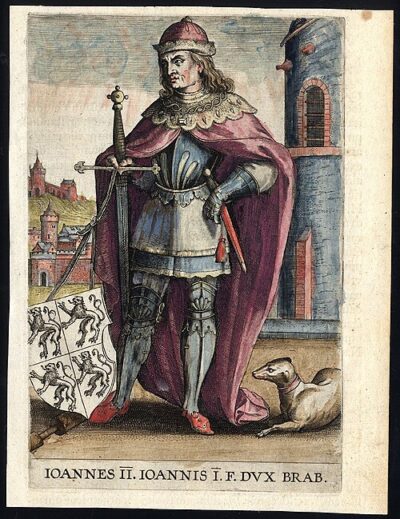
John II
John II was a Duke of Brabant. Born September 27, 1275. Died October 27, 1312, in Tervuren.
Facts
17 facts · 2 confirmed by two sources · 6 cited · 9 from one source
Where this comes from
Papalocal keeps its own record. It started from these sources; what each one said is kept here as it was copied, so a change on their side never changes this page by itself. Tap one to read its version.
What Wikidata says · copied November 18, 2026 · revision 2553981011
- Described as
- Duke of Brabant (1275-1312)
- Born
- September 27, 1275
- Died
- October 27, 1312
- Died in
- Tervuren
- Buried in
- Cathedral of St. Michael and St. Gudula
- Occupation
- politician
- Spouse
- Margaret of England (1290–) · 2 references
- Children
- John III · 1 reference; Jan van Wyvliet; Johan I van Wittem; Jan van Cordekin · 1 reference
- Father
- John the Victorious · 1 reference
- Mother
- Margaret of Flanders, Duchess of Brabant · 1 reference
- Siblings
- Jean Meeuwe; Marie of Brabant; Margaret of Brabant · 1 reference; Marguerite de Tervueren; Jean van der Plasch
- Wikipedias with a page
- 21
Wikidata item Q703470 (wikidata.org/wiki/Q703470), public domain (CC0). Copied November 18, 2026.
What Wikipedia says · copied November 18, 2026 · revision 1363178207
John II (27 September 1275 – 27 October 1312), also called John the Peaceful, was Duke of Brabant, Lothier and Limburg (1294–1312). He was the son of John I of Brabant and Margaret of Flanders.
John II succeeded his father in 1294 During the reign of John II, Brabant continued supporting a coalition to stop French expansion. He tried to conquer South Holland (district of medieval Holland) from the pro-French Count John II of Holland, but was not successful.
In 1309, the Crusade of the Poor besieged the castle of Genappe in Brabant because it was sheltering Jews. John sent an army that defeated the Crusaders, who incurred heavy losses. According to Chris Harman (2000), during different parts of the XIV century several attacks on Jewish merchants and Christian priests took place, and also awhich, typically, masses of people would march from town to town, looting and being joined by others during their march. Harman quotes the following:"Armed columns appeared, consisting of miserably poor artisans and labourers with an admixture of nobles who had squandered their wealth. These people begged and pillaged their way through the country, killing Jews but also storming…castles…In the end they attacked the castle of the Duke of Brabant…who three years before had routed an army of insurgent clothworkers and, it is said, buried its leaders alive." N. Cohn, The Pursuit of the Millennium. (London, 1970), p.102.
John, who suffered from kidney stones and wanted his duchy to be peacefully handed over to his son upon his death, in 1312 signed the famous Charter of Kortenberg. John died in Tervuren in 1312. He was buried in the Church of St. Michael and St. Gudula (now Brussels' cathedral).
- Born, in its opening lines
- September 27, 1275
- Died, in its opening lines
- October 27, 1312
From the Wikipedia article “John II of Brabant” (en.wikipedia.org/wiki/John_II_of_Brabant), by its contributors, under CC BY-SA 4.0 (creativecommons.org/licenses/by-sa/4.0/). Copied November 18, 2026; not changed.
Confirmed Two sources agree. Cited One source, and it names where it got it. One source One source, without a reference of its own. Sources disagree The sources disagree. We show the best-supported value and keep theirs below.
